| Ecclesiastical Latin | 19 apr 2023 |
| Overview
| This page offers basic resources for the study of Latin especially as used in and by the Catholic Church. |
| Background
|
Some suggest that Ecclesiastical Latin is easier to learn than is Classical (perhaps because Church Latin coincides more closely with modern vernacular usage by, for example, making greater use of prepositions), but it is easy to exaggerate the differences between the two great forms of Latin. In fact, Classical and Ecclesiastical Latin are one language.
|
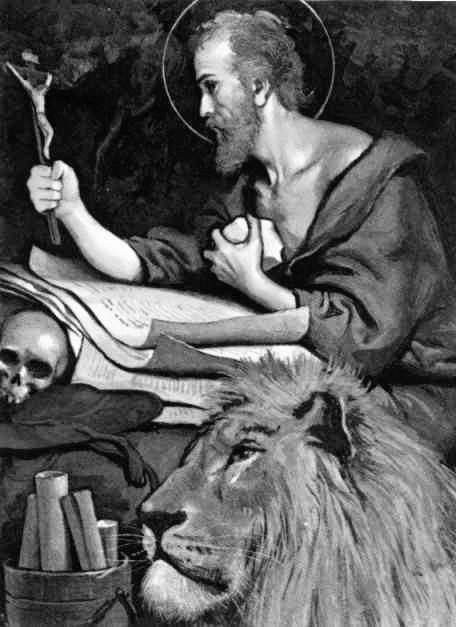 Ecclesiastical (or Church, or Medieval) Latin emerged from Classical Latin (especially the spoken form thereof, unhappily known as 'Vulgar Latin') beginning about the 4th century AD. Though gradually replaced for secular purposes by various vernacular tongues (Italian, Spanish, French, etc.), Ecclesiastical Latin has been used continuously by the Catholic Church as her primary language to the present day. Knowledge of Ecclesiastical Latin affords one direct access to nearly two millennia of accumulated Christian wisdom. The Church has repeatedly called on her priests to learn Latin (see Canon 249 below) and she recommends that all the faithful know their basic prayers in Latin.
 | Quick links
|
• Clementine Vulgate (BibleGateway) • Scriptural materials (Mark) | |
| Five good books for beginners
Purchases made through some links provide me a small commission from Amazon that I use to help cover the costs of this site. | Collins' Primer
| Collins' Answer Key
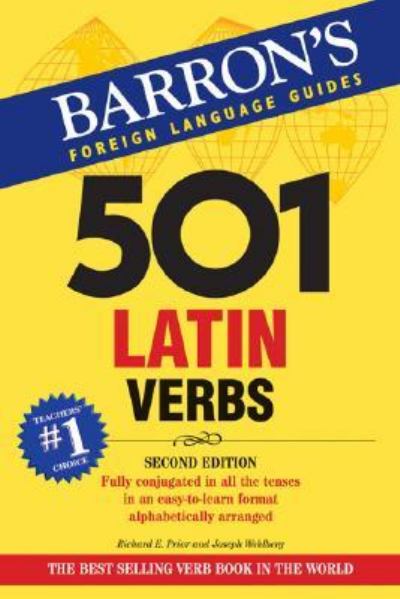
| 501 Latin Verbs
| Fairbairn
| Janson
|
| Can I learn Latin on my own? | Probably not. Certainly not if you do not already know a language such as Koine Greek. You see, Latin and English are not simply different languages in the way that, say, Spanish and English are different languages. Rather, Latin and English are different kinds of languages and they operate in very different ways. Almost anyone who grew up with an "analytic" language such as English or French (one whose syntax is driven largely by word order) needs someone to explain how a "synthetic" language like Latin (wherein syntax relies on things like 'case') operates—and then he needs them to re-explain it, and then to explain it again, and then yet again, because the linguistic differences between analytic and synthetic languages are considerable such that, we who grew up speaking analytic languages such as English, Spanish, or French now approach language with, as it were, our brains hard-wired for such languages. Ultimately understanding the exciting differences between English or French and Latin or Greek requires a change in how one thinks about language and language operations.
|
| The accent bugaboo | Today we need reminding that Latin is fundamentally an oral-audial language and is, therefore, best learned by listening to and speaking it. But because there are no native speakers of Latin left (moderns who speak Latin, even if fluently, learned their Latin from books and/or from other non-native speakers), disputes have arisen over the proper pronunciation of Latin. Currently Latinists observe two significantly different pronunciation systems, namely "Classical" (allegedly "restored") and "Ecclesiastical" (dubbed "Italianate"). Those learning under one system sometimes wonder whether they might be missing something vital in the other. I think not.
Both pronunciation schools have strong arguments behind them, though neither, in my opinion, fully demonstrates what Latin would have sounded like across the vast territories and through the many centuries in which it was spoken on a daily basis. But pronunciation disputes among academics need not be resolved before others can use Latin effectively and even beautifully in prayer, research, and daily life. Both pronunciation systems work just fine in practice and adherents of either school who belittle followers of the other embarrass only themselves and hinder the revitalization of Latin studies that is so necessary today.
|
| Some selected learning aids
| Grammar/syntax
• General Ecclesiastical Latin charts • Selected IV° and V° declension nouns • Basic indirect discourse (active and passive) |
|
| Other
• T. Feeney, "Addictissimus: how to close a Latin letter", The Jurist 17 (1957) 342-345. |
| — FOR — MEDIEVAL STUDIES | Thanks to the work of many generations of paleographers and textual critics we now have all the ancient texts in printed editions which are both easy to read and more correct than any of the surviving manuscripts. This is not, however, the case with texts from the Middle Ages, since there are many more of them [in fact, hundreds of thousands!] and they have attracted much less interest from Latin specialists. Many of them, even ones that are well worth reading, have been published using only one manuscript that happened to be to hand, even though much better manuscripts may exist. Many more texts have not been published at all, but are waiting in libraries for someone to read them and prepare an edition. There is a limitless amount of valuable work waiting to be done by those who would like to devote themselves to Latin and the Middle Ages. Tore Janson, A Natural History of Latin (Oxford, 2004) at 122, emphasis added.
| Janson |

| Canon Law
Seminarians are to acquire a knowledge of Latin which will enable them to understand and make use of the sources of so many sciences and of the documents of the Church. Vatican II, Optatam totius 13 (1965).
| 1983 CIC 249. Institutionis sacerdotalis Ratione provideatur ut alumni non tantum accurate linguam patriam edoceantur, sed etiam linguam latinam bene calleant necnon congruam habeant cognitionem alienarum linguarum, quarum scientia ad eorum formationem aut ad ministerium pastorale exercendum necessaria vel utilis videatur. Eng. trans. The program of priestly formation is to provide that students not only are carefully taught their native language but also understand Latin well and have a suitable understanding of those foreign languages which seem necessary or useful for their formation or for the exercise of pastoral ministry.
1917 CIC 1364. In inferioribus Seminarii scholis: ... 2° Linguas praesertim latinam et patriam alumni accurate adiscant.
S. C. Consist., lit. circ. Le Visite (16 iul 1912), n. 8. Nel ginnasio, pur attenendosi in linea generale ai programmi d'insegmento civili, si darà speciale impulso allo studio della lingua latina.
Leo XIII, enc. Depuis le jour (8 sep 1899), n. 14. Une fois en possession de la langue latine, qui est comme la clef de la science sacrée, ... les jeunes gens qui se destinent au sacerdoce passent du petit au grande Séminaire.
|
| Some thoughts for students
| Non tam praeclarum est scire Latine quam turpe nescire. Marcus Tullius Cicero (106-43) |
| | 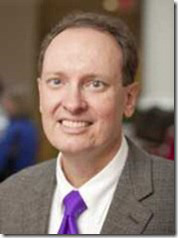 The discoveries that come with studying Greek and Latin are greater than what I mentioned [previously]. Fundamentally, these discoveries have to do with language, with communication. Greek or Latin can be a window in the world of how we express ideas. Your study of Greek and Latin will make you more conscious of how you think and communicate, and of how others do so. That study will make you more attuned to the subtleties and nuances of both logic and communication. It will make you more aware of the need for rigorous thought, speech, and writing. You will be better at using English because you have studied Greek or Latin. Fairbairn, Understanding Language (2011). The discoveries that come with studying Greek and Latin are greater than what I mentioned [previously]. Fundamentally, these discoveries have to do with language, with communication. Greek or Latin can be a window in the world of how we express ideas. Your study of Greek and Latin will make you more conscious of how you think and communicate, and of how others do so. That study will make you more attuned to the subtleties and nuances of both logic and communication. It will make you more aware of the need for rigorous thought, speech, and writing. You will be better at using English because you have studied Greek or Latin. Fairbairn, Understanding Language (2011). |
| | Est enim sermo Latinus lingua quaedam universalis, nationum fines transcendens atque talis, ut Sedes Apostolica in litteris et actis, ad universam Familiam catholicam spectantibus, eo adhuc firmiter utatur.
Est etiam animadvertendum fontes disciplinarum ecclesiasticarum maximam partem lingua Latina esse conscriptos. Quid vero dicendum de praeclaris operibus Patrum aliorumque magni nominis scriptorum, qui hunc ipsum sermonem adhibuerunt? Verae quidem scientiae compos non est putandus, qui linguam eiusmodi scriptionum mente non comprehendit, sed solum versionibus, si quae sunt, niti debet; quae tamen raro plenum sensum textus primigenii praebent.
Ad iuvenes ergo imprimis convertimur, qui hac aetate, qua litterae Latinae et humanitatis studia multis locis, ut notum est, iacent, hoc veluti Latinitatis patrimonium quod Ecclesia magni aestimat, alacres accipiant oportet et actuosi frugiferum reddant. Noverint ii hoc Ciceronis effatum ad se quodam modo referri: “Non tam praeclarum est scire Latine, quam turpe nescire”. John Paul II, alloc. Libenter (1978).
|
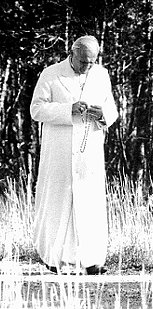
| Nullus sit sacerdos qui [linguam latinam] nesciat facile et expedite legere et loqui! Pius XII (1951).
| |
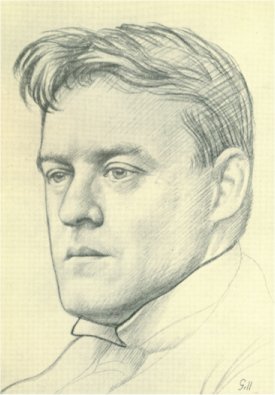 There can never be peace in our civilization nor a common understanding until we have a common language. No artificial language is worth considering. Latin ... which stands at the origin of all our common culture, is the obvious medium. ... [Yet] there has grown up in connection with the use of Latin the idea—false, but also natural—that there was something specially difficult about that tongue. On the contrary, it is the easiest of all foreign languages to learn because it is the most clear and logical, and because so many of our words in all languages are connected with it. Hilaire Belloc (1870-1953),
 | Resources for English speakers
| Grammars & Textbooks, Ecclesiastical
• John F. Collins, Primer of Ecclesiastical Latin [1985], Catholic University of America Press, 1988 et seq. The single best book for learning Latin as used by the Church from about the 4th century to the present day. Includes numerous liturgical and Scriptural examples. The original 1985 edition had some typographical errors which have been eliminated from later versions. Dunlap's answer key is now available (see above).
• Scanlon & Scanlon, Latin Grammar & Second Latin. A 2-volume set geared to philosophy, theology, and canon law. Order Latin Grammar here and Second Latin here. First appeared in 1948 and was widely used. This work was popular in religious circles before Vatican II, and aimed only at giving priests and, even more, nuns, an ability to read liturgical Latin. It is actually somewhat more sophisticated than that, and makes a good supplement for those working through Collins or Wheelock. But I do not think that it is a good stand-alone textbook for beginners, especially for those trying to learn Latin on their own. There are too few explanations offered and it really needs a teacher to explain things. In any event, try to find a used hard-back copy. The modern reprints I've seen are paperback, cheaply glued, and fall apart with minimal usage.
• Vincent Huber, Latin for Sisters: A Practical Guide to Breviary-Latin, Tabernacle and Purgatory Press, 1919, 1931. Neither intended for nor capable of teaching Latin as a whole, this work instead focuses on points of grammar and syntax needed to get a decent idea of what the prayers of the Divine Office mean. For all its obvious limitations, there are a good number of very practical translation tips in here, and it’s well worth a read by those who already have a decent grasp of Church Latin.
• Mary Perkins, Your Catholic Language: Latin from the Missal (1940). Using interlinear translations of Mass prayers, Perkins walks one through many (not all, despite her claim) of the important parts of ecclesiastical Latin grammar. Those points she discusses are quite clear and I find the book helpful as a set of self-guided exercises for those who can get fuller explanations elsewhere. (nb: I have seen used copies for sale on the Internet, astonishingly over-priced.)
• Rhoda Hendricks, Latin Made Simple, Cadillac Pub., 1962. Part of a self-teaching mini-encyclopedia series, this book, while intended as an overview of classical Latin, is actually just as useful for learning ecclesiastical Latin, and so I list here. Makes an excellent supplement for a full grammar book.
• O. Kuhnmuench, Liturgical Latin (Loyola Chicago, 1939). Little more than organized classroom readings; a few grammatical and vocabulary tips.
• H. Nunn, An Introduction to Ecclesiastical Latin (Cambridge, 1922). The more I use this work, the more I like it. Written by a classicist who did not want to waste words. A reference work, not a teaching text.
• A. Blaise, A Handbook of Christian Latin: Style, Morphology, and Syntax [1955], Eng. trans from French G. Roti (Georgetown University, 1994). Another more recent find, but looks quite interesting.
Grammars & Textbooks, Classical
• Basil Gildersleeve (1831-1924), Gildersleeve’s Latin Grammar [1867], as revised by Gonzalez Lodge, (Dover, 2009) 546 pp.
• Frederick Wheelock, Latin: An Introductory Course Based on Ancient Authors, Barnes & Noble Outline, 1956 et seq. Order here. One of the two or three really great modern grammars for classical Latin, this one has the advantage of teaching declensions in the usual ecclesiastical order, and providing copiously footnoted sample readings. There is also available by Groton & May a short reader, Latin Stories, Bolchazy-Carducci, 1986, 1989, designed around Wheelock.
• Allen & Greenough’s New Latin Grammar for Schools and Colleges, Ginn & Company, 1888, 1903. Order reprints here. A gold mine of technical classical Latin grammar, but still quite useful for those whose needs lean toward ecclesiastical Latin.
• Robert Henle, Latin Grammar (Loyola, 1945 and later), not to be confused with Henle's famous multi-volume textbooks, this single volume grammar is packed with clear illustrations or technical points. Order here.
• J. Mountford, “Bradley’s Arnold” Latin Prose Composition, Longmans, Green & Co., revised 1938. Reworking of a famous textbook, the grammar is designed to facilitate Latin-to-English reading and English-to-Latin composition. Assumes that the student already has a solid grasp of declensions and conjugations.
• Jenny’s First Year Latin, Allyn and Bacon, 1979 et seq. An engaging way for younger people to learn classical Latin, (lots of neat pictures, etc.) Order here. Nicely done (though I have not used it with kids.)
• H. Oerberg, Lingua Latina, Nature Method Language Institutes, 1954, 1965. Several volumes, teaches Latin by actually reading it first (with the help of pictures and simple sentences) and then explaining, albeit briefly, the grammar. Interesting approach, but requires the assistance of a tutor.
• C. Bennett, A Latin Grammar (Allyn & Bacon, 1895). The few times I have used it, it's been helpful. Think of it as simplified version of Allen & Greenough.
• Michael Wilson, Essentials of Latin Grammar (Passport Books, 1991). Order here. A recent find, has a knack for pointing out things that others take for granted. Very useful.
|
|
+ + +
It is not surprising that a comprehensive dictionary has eluded us. Almost none of the modern dictionaries covers the whole alphabet, but for basic purposes it is possible to get by with a good dictionary of Classical Latin and a selective dictionary of Medieval Latin. R. Sharpe, writing in Mantello & Riggs, Medieval Latin, at 93.
| Dictionaries (most "classical" but quite useful for ecclesiastical Latin)
• Lewis & Short, A Latin Dictionary, Oxford University Press. Among one-volume, still-affordable, dictionaries, this one reigns supreme. Always called "Lewis & Short". Essential for advanced work.
• Cassell’s New Latin Dictionary, Funk & Wagnalls. Excellent. Second only to Lewis & Short.
• The New College Latin & English Dictionary, Bantam Books. Very useful.
• Langenscheidt Pocket Latin Dictionary. From a German company famous for dictionaries, it’s small, rugged, and easy to use. Trademark yellow, waterproof covers. Great for camping trips.
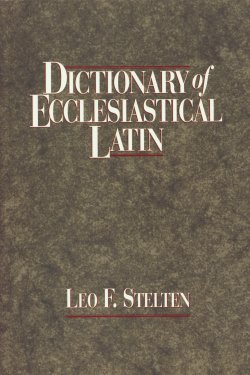
• Leo Stelten, Dictionary of Ecclesiastical Latin
• Roy J. Deferrari, A Latin-English Dictionary of St. Thomas Aquinas [1960], St. Paul Editions. Well-regarded, and large, but a bit over-specialized to be one's only Latin dictionary.
• A. Souter, A Glossary of Later Latin to 600 AD (Oxford, 1949 on). Useful.
• Latin Dictionary and Grammar Aid (University of Notre Dame).
• Wilfrid Diamond, Dictionary of Liturgical Latin (Bruce, 1961). Why isn't this better known? It's quite nicely done.
• J. Bretzke, Consecrated Phrases: A Latin Theological Dictionary, Latin Expressions Commonly Found in Theological Writings (Liturgical Press, 1998). Several small but annoying errors.
• Freund’s edition of Leverett’s New Lexicon of the Latin Language (Lippincott, 1850), sometimes bound with Leverett’s English-Latin Lexicon of 1837.
Audio Learning Systems
• S. Seidl, Cursus Linguae Latinae Vivae, Family of St. Jerome, text and audio tapes or disks. Geared to ecclesiastical (emphasis on Scriptural) Latin, this series by a famous Vatican Latin master (and others) teaches Latin as the living language it is. Comes with printed support materials. Can be used a stand-alone, but is even better when fleshed out with a standard grammar book. Also, many recordings of workshop on topics discussed in Ecclesiastical Latin. Contact: Family of Saint Jerome (Familia Sancti Hieronymi), 507 S. Prospect Ave. Clearwater, Florida 33756.
• Educational Services, Language/30 Latin, 2 audio tapes with Latin phrases and a very little grammar. Ruthlessly classical in pronunciation (except for a few minutes), but interesting for a one-time listen.
Other Materials
• F. Mantello & A. Rigg, eds., Medieval Latin: An Introduction and Bibliographic Guide (Catholic University of America, 1996). An amazing resource that I only recently discovered. Not a grammar, lexicon, or reader. Instead, just about everything else!
• R. Moore, Comparative Greek and Latin Syntax (Bell, 1934/1948; Bristol Classics, 2000). Even if you don't know Greek, this is a still very handy reference for Latin syntax. Highly-regarded (and might make you want to take the plunge into Greek, after all!)
• J. Mantinband, Dictionary of Latin Literature (Philosophical Library, 1956). Not vocabulary, of course, but rather lists works, authors, etc. Surveys up to the Renaissance.
• Charles Grandgent (1862-1939), An Introduction to Vulgar Latin (Heath, 1907) 219 pp. Aside from a lengthy discussion of sound production, I found this a very interesting explanation, not just about about the emergence of Vulgar Latin, but about the launch of early modern Romantic languages. Packed with information, more of a reference work than a sit-down read.
|
| Two summer Latin learning options
I am often asked for my opinions on various 'Summer Latin Learning' opportunities. What follows are my observations and opinions. | Summers are an excellent time to undertake concentrated language learning, both for high-school, college, and graduate students who tend to have more free time in summers, and for working adults who wish to make something special of their vacation times. Summer language learning allows one to focus almost exclusively on the language in question while being free of most other demands and distractions. In particular, those who wish to acquire a speaking knowledge of a foreign language will benefit from the immersion or near-immersion context in which several summer language learning programs operate.
Setting aside summer programs such as the University of Kentucky (which I have not attended, but of which I hear good things, and which seems to specialize in Classical Latin) there are currently two major, week-long, summer programs for developing one's speaking ability in Ecclesiastical Latin, namely, the Cenaculum sponsored by the Family of St. Jerome which I have attended four times, and Veterum Sapientia sponsored by SALVI which I have attended once.
I can recommend both programs without reservation, but they do have different 'feels' to them, and knowing that fact might help one to chose between them (if, pro dolor, one cannot attend both!)
The Cenaculum sponsored by the Family of St. Jerome (a canonical association of the faithful) is an immersion Latin program that welcomes participants of all Latin speaking levels, including total beginners. Naturally, the more Latin one brings to the Cenaculum the more Latin one will learn in it. There are no Latin classes per se at the Cenaculum, but rather, there are excellent lectures and talks in Latin on numerous topics of interest to persons desiring to learn Church Latin, Latin-only question-and-answer periods, considerable opportunity to participate in Latin liturgical and devotional exercises, and plenty of Latin speakers able to and willing to speak with Latinists of all levels.
The Cenaculum usually meets in the Southern United States. On-site housing and decent meals are included in the very reasonable program fee. All ages attend, including some little kids (and yes, they learn some Latin) but clergy religious and laity also come, as do seminarians and college students, lawyers, house-painters, moms, astrophysicists, retirees, and even a few Latin teachers! There are usually Latin enthusiasts from other countries as well for Latin is, if course, the international language of the Church.
Veterum Sapientia is sponsored by SALVI (a non-profit educational group) and is an immersion Latin program that, more lately, has been limited to clergy, religious, and seminarians. They suggest that one arrive with a decent background in Latin grammar and syntax (but they do not require prior Latin speaking experience). Workshops run more like classes are offered at Veterum but these are always geared toward acquiring an ability to think and speak in Latin. Program fees are reasonable, food and housing plans seem to vary with the specific summer in question.
I personally know many of the presenters at both groups (over the years several presenters and participants of the Cenaculum have attended Veterum, and vice versa) and all of them are really, really good. I think the Cenaculum has a little more 'laid-back' pace to it as compared to Veterum (indeed, for a while the Cenaculum week was known as Feriae Latinae), so, for those nervous about taking that first plunge into spoken Latin, I suppose a slight edge could be given to the Cenaculum. Also, the Cenaculum is not limited to priests, etc., though plenty of priests and do attend it. In any case, as I said, the presenters in both programs are truly skilled speakers and gracious teachers. There is no snootiness in either program and the progress made my participants who dive into spoken Latin with both feet is, time and again, truly remarkable. I don't know this for certain, but my guess is, both programs have a high number of repeat attendees. That itself says something.
Bottom line: both programs are terrific. There is no wrong choice here.
|
| | Materials on this website represent the opinions of Dr. Edward Peters and are offered in accord with Canon 212 § 3. This website undergoes continual refinement and development. No warranty of completeness or correctness is made. Dr. Peters' views are not necessarily shared by others in the field nor are they intended as canonical or civil advice. Some links provided for those looking to purchase books discussed on this site lead to Amazon Associates. Purchases made through such links provide me a small commission from Amazon that I use to help cover the costs of this site. | |

|
| CanonLaw.info Homepage & Site Directory / Help support CanonLaw.info / Original Materials © Edward N. Peters |
|
