CanonLaw.info


Canon Law
   Books
   Articles/Reviews
   Speaking/Media
   Canonistics
   Other
Liturgy
   Documentation
Catholic Issues
   Articles/Reviews
   Latin & Greek
   Other
Personal
   Special Needs
   Fine Films
   Dessert Wines
   In Memoriam
   Links
Notices/Vendors
E-Mail Webmaster


This website is best

viewed 1152 x 864

Edward Peters


Updated

8 Dec 2008


   "To work for the proper implementation of the Code is to work for the up-building of the Church herself. It is to work for the salvation of the world. It is to play an extraordinarily constructive role in continuing the redemptive mission of Christ himself."

Pope John Paul II


Background on

the Roman Rota


Common

Canonical

Citations


Canon Law Canonistics


1. A.  Codex Iuris Canonici auctoritate Ioannis Pauli PP. II promulgatus (1983). [The 1983 Code of Canon Law, Latin Text, approx. 1.45MB]

         There are several places on the Internet where the Latin text of the 1983 Code may be found. Most of these, however, contain errors. The version posted here has been diligently examined by Dr. Peters, but some errors might still haunt the file. Anyone spotting such errors is earnestly requested to email the Webmaster so that prompt corrective action might be taken.


1. B. Other Electronic versions of the 1983 Code of Canon Law

1. Latin text of the 1983 Code, but including extensive cross-links, is available at IntraText CT. 

2. English text of the 1983 Code, available at IntraText, as housed on the Vatican's website. The text appears to be the revised American English translation, but it bears a Vatican (Libreria Editrice Vaticana) copyright.

3. British-Irish English translation of the 1983 Code, including extensive cross-links, available at IntraText CT. 

4. Polish Translation of the 1983 Code of Canon Law , including extensive cross-links, available at IntraText CT. 

5. German Translation of the 1983 Code of Canon Law , including extensive cross-links, available at IntraText CT. 

6. Spanish Translation of the 1983 Code of Canon Law , including extensive cross-links, available at IntraText CT. 

7. Italian Translation of the 1983 Code of Canon Law , including extensive cross-links, available at IntraText CT. 

8. French Translation of the 1983 Code of Canon Law , including extensive cross-links, available at IntraText CT. 

9. Slovak Translation of the 1983 Code of Canon Law , including extensive cross-links, available at IntraText CT. 


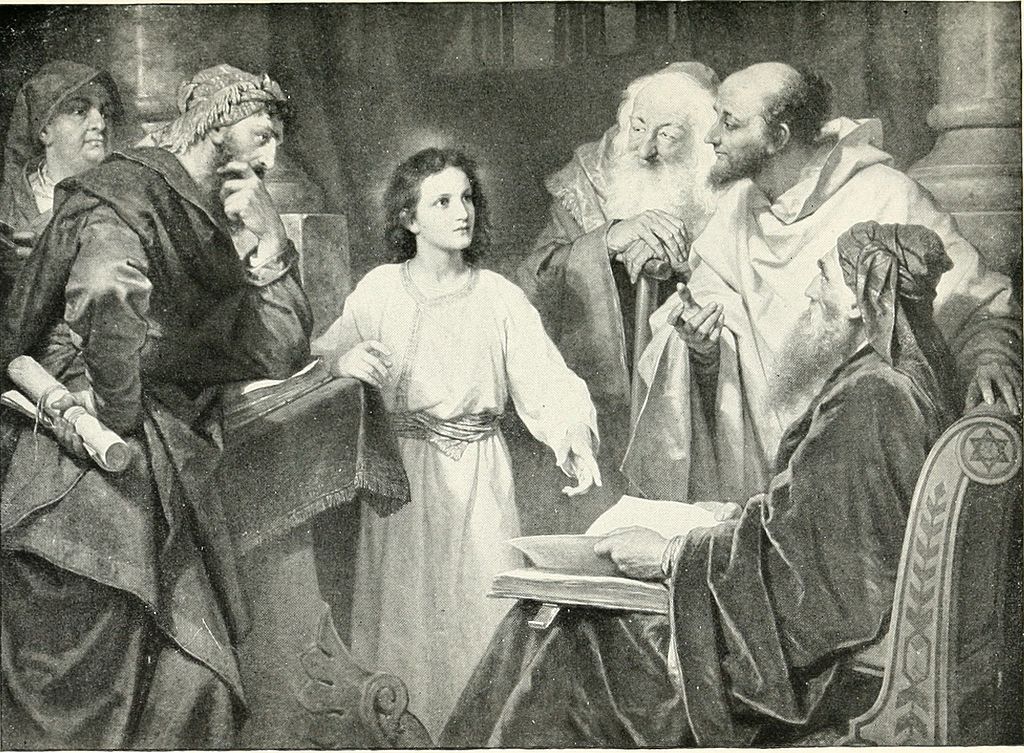
Christ among the Doctors

Spanish Master, c. 1496


Key Figures in the Re-Codification of Canon Law


Pope John XXIII

Card. Pericle Felici

Card. Castillo-Lara

Pope John Paul II


     The complex process of the re-codification of canon law began in early 1959 and was completed in late 1982. Dr. Peters' textual history of the reform of the Code of Canon Law, Incrementa in Progressu 1983 Codicis Iuris Canonici, will be released soon from Wilson & Lafleur. Watch this website for more details as they are available.


II. Pontifical Council for the Interpretation of Legislative Texts (formerly: "The Pontifical Commission for the Authentic Interpretation of the Code of Canon Law".)


This council, part of the Roman Curia, is (except for the Pope) the only office authorized to interpret "authentically" the meaning of the Catholic Church's various legislative texts, chiefly, but by no means exclusively, the 1983 Code of Canon Law (1983 CIC 16, & ap. con. Pastor Bonus, art. 154). The President of the Code Council is Abp. Juliano Herranz of Spain.


Abp. Julian Herranz Casado


Excerpts from a recent Interview with Cdl. Herranz-Casado


VATICAN CITY, OCT. 20, 2003 (Zenit.org).- The president of the Pontifical Council for the Interpretation of Legislative Texts believes that his appointment as cardinal is an acknowledgment of the pastoral importance of canon law.

Spanish-born Archbishop Julián Herranz Casado, 73, will be among the new cardinals elevated by John Paul II in the consistory on Tuesday. Archbishop Herranz will be the second cardinal who is a member of the Personal Prelature of Opus Dei.

Q: What has this call to the College of Cardinals meant for you?

     Archbishop Herranz: For me, this choice of the Holy Father means more than an acknowledgment of my personal qualities, which are few, but, a triple manifestation of appreciation. In the first place, I would say of canon law, of the laws of the Church, as the Pontifical Council for the Interpretation of Legislative Texts, which I preside over, is concerned with this very important pastoral function of the Church.

     In the second place, I think it has been an expression of thoughtfulness toward Spain… because of the spiritual richness of its mystics, and because of the vigor and intellectual creativity of so many theologians and canon lawyers of world renown. In the third place, I think this appointment is yet another expression of appreciation of the Opus Dei, the institution to which I belong. …

Q: Do you think that in recent years interest in legislative texts and canon law has waned in the Church for the benefit of mere pastoral action?

     Archbishop Herranz: No, no, just the opposite. I think there has been a recovery of the awareness that the pastoral "munus," pastoral action, is like a tripod. It rests on three different functions which are, nevertheless, inseparable: the teaching function, which we call "munus docendi"; the liturgical and sacramental function, "munus santificandi"; and the governing function, "munus regendi" which consists above all in having the laws of the Church applied.

     I recently reminded the Holy Father: "Neither in theory nor in practice can we do without the exercise of the “munus regendi,” as a means to declare, determine, guarantee and promote intra-ecclesial justice."

     They are three absolutely necessary functions. If one is not applied, the tripod collapses. Pastoral action would be incomplete, immature; more than that, it would seem to give up, to be comfortable and even harmful, if there was no government. Of course, sometimes it is easier than others to have the laws of the Church respected and applied. It might be that the other two are easier, but the latter is necessary.

Q: Is there not in some sectors a clash between charism and law, charity and law?

     Archbishop Herranz: In the very recent past, there was much demagogy made of these false comparisons, which in reality are inappropriate for three principal reasons. In the first place, because Jesus Christ founded the Church, not only as a community of faith, hope and charity, but as a hierarchically organized society. And every society needs law. Therefore, the existence of law in the Church is a foundational will of Christ.

     The second reason is that the whole mission of the Church, the whole evangelical message, is concretized -- as Jesus summarized it at the Last Supper -- in the "new commandment" of charity. But it must not be forgotten that the first step […] of charity is justice. And then, in the third place, one must keep in mind that law in the Church is not -- as some think -- a mere instrument of power in the hands of the hierarchy.

     It is the totality of rights and duties that help all the faithful of the Church, from the Pope to the last baptized person, to participate actively and in an orderly manner in the unique and common mission of taking Christ to the world, each one according to his own vocation and canonical standing. … ZE03102030


IlI. Codex Iuris Canonici Pii X Pontificis Maximi iussu digestus Benedicti Papae XV auctoritate promulgatus (1917).

http://www.theol.u-szeged.hu/~laurin/cic1917.html


Pope St. Pius X

Launched the 

Codification of Canon Law

Pietro Cardinal Gasparri

Architect of the 

Pio-Benedictine Code

Pope Benedict XV

Promulgated the 

1917 Code of Canon Law


     "Every man has his special mission in life. Mine was the codification of Canon Law and the support of Benedict during the [First World] War. These two tasks are now completed." Cdl. Gasparri on 22 Jan. 1922. His Eminence did not mention his: 1) authoring of De Matrimonio in 2 vols., the most influential treatise on marriage in since Gratian; 2) negotiation of the Lateran Treaty seven years later, and 3) editing of 7 out of 9 volumes of the 1917 Code's Fontes. Most men would be proud to have accomplished any one of these tasks.


For a look at the men behind the man behind the 1917 Code, 

see Pontifical Commission for the Codification of Canon Law.


For certain documents associated with the early years of codified canon law,

see Selected Translations for use in studying the 1917 Code.


IV. Corrections to various printed Latin editions of the 1983 Code


          In the course of doing close textual work on the 1983 Code, Dr. Peters has noted the following errors in various printed editions of the 1983 Code. These lists will be updated as other errors are discovered. The underlined words are those that were printed erroneously in the various editions, and [bracketed] words should not have appeared. Discrepancies in punctuation are not marked, nor are merely orthographic variations. These tables are a work-in-progress. Those noting additional errors are kindly requested to notify Dr. Peters so that corrections can be posted here.


       1. Codex Iuris Canonici auctoritate Ioannis Pauli PP. II Promulgatus, (Typis Polyglottis Vaticanis [1983].) This was the very first

bound version of the 1983 Code to appear outside of the Acta Apostolicae Sedis. There are too many errors in this printing to list here.

Copies of this work should be discarded.


        2. Code of Canon Law, Latin-English Edition, prepared under the auspices of the Canon Law Society of America, (Canon Law

Society of America: Washington, DC, 1983). ISBN: 0-943616-19-0/ 0-943616-20-4.

 
Provision Should Read
Canon 79 …firmo praescripto can. 81.
Canon 144 …quibus in cann. 882, 883, 966…
Canon 174 § 3 …pro non appositis habeantur…
Canon 310 …privata quae uti persona iuridica...
Canon 382 § 4 …fiat, [praesente] clero et populo adstantibus.
Canon 385 …cura vocationibus sacerdotalium et missionalibus ...
Canon 395 § 3 …et Corporis et Sanguinis Christi...
Canon 447 …pro christifidelibus [eius] sui territorii…
Canon 458, n. 1 …communicare, itemque alia [etiam] acta…
Canon 483 § 1 …fidem facit, [et qui] quod attinet sive ad quamlibet…
Canon 527 § 2 …paroeciae [communicata] notificata, locum tenet...
Canon 542 …ad normam can. 517, § 1, alicuius...
Canon 555 § 2, n. 1 …ad normam can. 279, § 2;
Canon 749 § 2 …coadunati qui, ut fidei…
Canon 762 …ministri [cum] inter quorum praecipua…
Canon 779 …communicationis socialis instrumentis…
Canon 780 idemque Ecclesiae…
Canon 822 § 3 …etiam his instrumentis…
Canon 924 § 1 …eucharisticum sacrificium offerri debet…
Canon 1059 …etsi una tantum pars sit catholica, regitur ...
Canon 1431 § 1 ...promotoris iustitiae [a] lege praecipiatur...
Canon 1446 § 3 ...ad normam cann. 1713-1716...
Canon 1508 § 2 ...deposuerit in iudicio.
Canon 1673 ...reservatae, competentia sunt:
Canon 1742 § 1  ... a consilio presbyterali constituto,...


        3. Commento al Codice di Diritto Canonico (Pontifica Universita Urbaniana: 1985).
Provision Should Read
Canon 530 n. 7 …extra ecclesiam sollemnes;
Canon 924 § 1   …eucharisticum sacrificium offerri debet…
Canon 804 § 2 …sollicitus sit ut qui ad...


        4. Pontificia Commissio Codici Iuris Canonici Authentice Interpretando, Codex Iuris Canonici: Fontium Annotatione et Indice Analytico-Alphabetico Auctus (Libreria Editrice Vaticana: 1989) ISBN: 88-209-1610-X.


Provision Should Read
Canon 174 § 3 …pro non appositae habeantur.
Canon 225 § 1 …divinum salutis nuntium ab universes…
Canon 231 § 2 …quoque iuris civilis praescriptis, necessitatibus…
Canon 242 § 1 …seminario tradendae definiantur summa principia…
Canon 263 …sustentationi necnon magistrorum emunerationi…
Canon 851  …debite praeparetur oportet; itaque:…
Canon 998  …confertur eos liniendo oleo atque verba …
Canon 1018 § 1, n. 2 …Pro-vicarius et Pro-praefectus apostolicus.
Canon 1026  …ab iisdem recipiendis avertere.
Canon 1083 § 1 Vir ante decimum sextum aetatis annum…
Canon 1258 ...sed etiam quaelibet persona iuridica...
Canon 1524 § 1 In quolibet statu...
Canon 1698 § 1 Una Sedes Apostolica cognoscit de…
Canon 1720, n. 3 ...si de delicto certo constet…
Canon 1728 § 1 …servatis specialibus normis de causis…


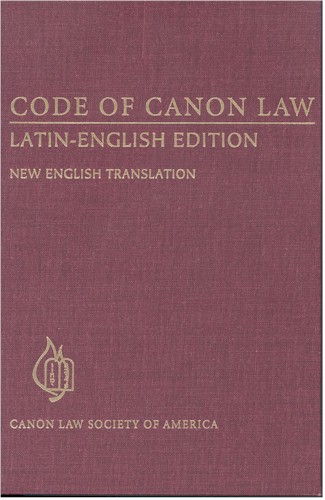
        5. Code of Canon Law, Latin-English Edition: New English Translation, prepared under the auspices of the Canon Law Society of America, (Canon Law Society of America: Washington, DC, 1999). ISBN: 0-943616-79-4.

Provision Should Read
Canon 120 § 1 ...ad normam statutorum esse desierit.
Canon 193 § 1 ...nisi ob graves causas atque...
Canon 520 § 2 ... commissio, de qua in § 1, fieri...
Canon 1259  ...iustis modis iuris sive naturalis...
Canon 1269 ...si in dominio privatorum sunt...
Canon 1289 ...arbitraria dimissione damnum...
Canon 1312 § 1, n. 1 ...seu censurae, quae in cann. 1331-1333...


V. Eastern Canon Law


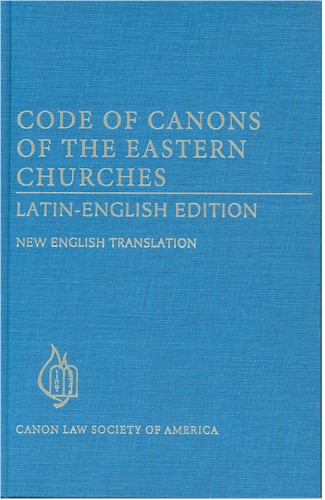
1. All of the Eastern Catholic Churches are governed, with rare exceptions, not by the 1983 Code of Canon Law, but rather by their own Code as promulgated by Pope John Paul II on 18 October 1990 (going into effect 1 October 1991). The text of this code is available in Latin and English as follows: Code of Canons of the Eastern Churches: Latin-English (Canon Law Society of American Washington, DC, 1992) ISBN: 0-943616-52-2 or 0-943616-53-0.


Click here for a English version (Intra-Text) of the CCEO.

Click here for a Latin-Polish PDF version of the CCEO

Click here for a Romanian version (Intra-Text) of the CCEO.


or just Click here to go to Ulrich Rhode's site featuring several CCEO text links.

     This 1990 Code replaces the (incomplete) canon law that had been in effect for Eastern Catholics up to that time. Pope Pius XII had promulgated certain parts of Eastern canon law in a series of motu proprios, as follows:

  m.p. Crebrae allatae [on marriage law] (22 Feb 1949), AAS 41 (1949) 89-119.
  m.p. Sollicitudinem Nostram [on procedural law] (6 Jan 1950), AAS 42 (1950) 5-120.
  m.p. Postquam Apostolicis Litteris [religious, temporal goods, terms] (9 Feb 1952), AAS 44 (1952) 65-152.
  m.p. Cleri sanctitati [law of persons] (2 Jun 1957) AAS 49 (1957) 433-603.

These four documents, all now abrogated, were never published officially as a set, but some private bindings, known unofficially as the Codificatio Iuris Canonici Orientalis, I-IV, are occasionally found.


The "fontes" edition of the Eastern Code is: Pontificium Consilium de Legum Textibus Interpretandis, Codex Canonum Ecclesiarum Orientalium auctoritate Ioannis Pauli PP. II promulgatus, Fontium Annotatione Auctus (Libreria Editrice Vaticana, 1995)


2. Most pontifical faculties of [western] canon law offer only a basic survey course in Eastern canon law. One however, offers course work leading to a doctorate in Eastern canon law, a J.C.O.D., namely: Faculty of Oriental Canon Law, Piazza S. Maria Maggiore 7, 00185 Rome, ITALY. In addition, one school offers a "diploma" in Eastern canon law, namely the Faculty of Oriental Law, Dharmabam Vidya Kshetvam. There is, as yet, no pan-textual commentary on the Eastern Code.


3. On-line laws of the Syro-Malabar Church.


Vl. Canonical Institutions 


    Canon Law Faculties

    Canon Law Societies

    Canon Law Journals (hosted by Rev. Ulrich Rhode, JCD)


Top || Home || Canon Law || Liturgy & Sacraments || Catholic Issues || Personal