This site best viewed at 1152 x 864 with Text size "Medium" or "Larger".
Edward Peters
The following observations represent my opinions. While I believe that the opinions expressed here are consistent with c. 212 § 3, I submit all to the ultimate judgment of the Catholic Church. The letter “c.” stands for “canon” of the 1983 Code of Canon Law. All translations are mine, even if they coincide at times with those of others. Dr. Edward N. Peters
Note: If you have subscribed to Canon Law Blog but do not receive timely notices of updates, we might have a bad email address for you. With each notice, a few emails are returned to us, and we have, of course, no way of letting those subscribers know there is problem.
In the Light of the Law:
a canon lawyer's blog on current issues
Blog Archives 2006
Tuesday, December 05, 2006
Just in time for Christmas!
Still haven't found anything for that hard-to-buy-for canon lawyer on your Christmas list? Looking for something completely original, very useful, and really, really cheap (as in, free)? Search no more! Just send that special guy or gal a link to Dr. Ed's solaranite-powered guide to the footnotes of the 1917 Code. It will help if your special canon lawyer likes Latin, old books, and Plan 9 from Outer Space (of course,that's true for all of us), but it doesn't really matter: here is this year's perfect gift for canonists. A Blessed Advent, folks.
I find the hoopla surrounding Rome's decision to translate "pro multis" as "for many" (instead of as now, "for all") in the canon of the Mass disconcerting. Are we so starved for effective exercises of ecclesiastical authority that we must greet this decision as a triumph on par with, say, the fall of the Berlin Wall? Personally, I think no congratulations are in order for having finally correctly translated a phrase that Latin students should know by the time they finish Chapter 4 of Collins' Primer of Ecclesiastical Latin. Rather than dwell, though, on why ICEL, the USCCB, and the Holy See each in their turn allowed such an obviously wrong translation to stand for so long, I will simply recall the words of Psalm 122 and be happy that our feet (on this point anyway) are standing within the gates of Jerusalem. At least, that was my plan until I came across an interesting comment posted by a priest. Obviously thoughtful and desirous of bringing sound liturgy to his people, he wrote that, with a smattering of Latin and some input from those who knew more, he had long ago substituted "for the many" in place of "for all" when he celebrated Mass. He justifies his action on the grounds that "for all" was clearly wrong and that people deserve a correct translation of the Mass. He added that, if his bishop were to direct him to stop the practice, he would do so immediately. I think this approach is quite wrong. 1983 CIC 846.1 states "[T]he liturgical books approved by the competent authority are to be observed faithfully; accordingly, no one is to add, omit, or alter anything in them on one's own authority." Sacrosanctum Concilium 22.3 made exactly the same point, and expressly stated that priests were bound by this norm. The Code and Council are unambiguous here. Thus, one no more needs a personal precept from a bishop in order to be bound to observe this liturgical law, than one needs a personal directive from an IRS agent to file one's taxes by April 15, or needs a direct order from a traffic cop to be required to obey a stop sign. Quite simply, as John Paul II stated when he promulgated the 1983 Code, "canonical laws by their very nature are to be observed." (my emphasis) But perhaps the Bard (in Merchant of Venice, Act IV, Scene 1) put it best: BASSANIO: I beseech you, Wrest once the law to your authority: To do a great right, do a little wrong. PORTIA: It must not be . . . 'Twill be recorded for a precedent, And many an error by the same example will rush into the state: it cannot be. Bassanio was a good man. But he underestimated the harm that could arise from trying to do good in a bad way. He is a lesson for all us tempted to impatience in these times so needful of reform.
Does Fr. Gravel really have permission to hold office?
LifeSiteNews is reporting that the Canadian priest Raymond Gravel, notorious for his vociferous disagreement with Church teaching on just about every major social issue, has obtained permission from his bishop to run for national governmental office. This claim, however, seems impossible to reconcile with sound canon law. Under the 1983 Code, Catholic priests are flatly prohibited from holding governmental office: Canon 285.3 plainly states "Clerics are forbidden to assume public offices which entail a participation in the exercise of civil power." The legislative history of this norm makes obvious the Legislator's intent to eliminate any exceptions to this rule. See Peters, Incrementa in Progressu at 234. Unlike those situations where a priest might be given permission to serve as an agent for lay persons or as co-signer of a loan, or to hold office in unions or political parties (see 1983 CIC 285.4 and 287.2), there is no provision in Canon 285 for bishops to grant a priest permission to hold governmental office. None. Presbyteral council "approval" of any alleged "permission" is completely irrelevant. The Holy See could, of course, grant permission for a priest hold governmental office, but there is not the slightest chance that Rome would do anything to enable this cleric to spread his kind of scandal at the national level. Prescinding from other canonically confusing aspects of this case, the only theory by which Fr. Gravel might have been given episcopal permission to seek national office would be in virtue of a dispensation from disciplinary law under 1983 CIC 87 and 90. The standard canonical authors recognize such a possibility, but when commenting specifically on the prohibition against priests holding major governmental office, they stress how low is the likelihood that such permission would ever "contribute to the spiritual good" of those under a bishop's care. In Fr. Gravel's case, of course, the assertion that such permission might serve a "spiritual good" would be laughable. In short, it seems that someone has either thoroughly confused Canon 285 with Canon 287, or has deeply disregarded Canons 87 and 90. Either way, this situation needs correction. (A minor clarification on the LSN report: the canonical prohibition against priests holding governmental office did not start with the Drinan case in the USA; it was part of the Pio-Benedictine Code (see 1917 CIC 139), though Fr. Drinan's conduct in office through the 1970s certainly helped galvanize renewed enforcement of the norm.) Same Day Update: Another Canadian priest, Fr. Thomas Dowd, writes that Fr. Gravel's "permission" to hold secular office was contingent upon his accepting certain restrictions on his ministry. Those restrictions seem like some of the "other canonically confusing aspects of this case" I referred to above. Interesting, but it doesn't change my analysis. There are no conditions upon which episcopal "permission" to hold governmental office can be given to a priest. Again, if this is not a dispensation case, as doubtfully valid as that dispensation would be, it's nothing. Updates, November 1: Skimming some other comboxes on this topic, I see some folks confusing deacons and priests here. Please note, permanent deacons, per 1983 CIC 288, are not included under the c. 285 prohibition at all. Technically, they are not an exception to the rule; they simply don't fall under it to begin with. It is therefore confusing for some to be asserting that permanent deacons can hold secular office "if they have their bishop's permission". Per the Code, permanent deacons don't need permission at all, since they are not prohibited in the first place. BTW, I provide canon numbers in my posts precisely so people can look up these things themselves. But too many folks don't do that before posting what they think are corrections. A French-language communiqué from the Diocese of Joliette, citing no canons, asserts that Fr. Gravel has episcopal approval to run for civil office on condition that he basically lays aside priestly ministry for the time of his political activity. (Translation of communiqué and pointed questions from CWN here.) Whatever else may be said about Fr. Gravel's overall situation, I see no basis in canon law for this sort of "compromise". Update, November 2: Jimmy Akin is predicting that Rome will intervene and order Fr. Gravel to stand down. This seems, indeed, the last hope that the Catholic Church in Canada will be spared its version of the Drinan disaster. Update, November 14: There's now another one in Toronto. I can only say again, I see no basis in canon law for granting "permission with conditions" in these cases. For priests to hold governmental office requires dispensation, or it is canonically illegal. That is not a verbal quibble on my part. The character of "permission" differs in several respects from that of "dispensation" and, if history is any guide here, instances of misapplied canon law usually tend to get worse, not better, over time.
Fr. Daniel Gallagher, a colleague here at Sacred Heart Major Seminary in Detroit, has just published a fine essay on the importance of Latin training for men preparing for priesthood. Of course, I think that anything promoting Latin, and anything by Fr. Gallagher, warrants reading, but among the many excellent points made about the importance of Latin competence was Fr. Dan's highlighting of 1983 CIC 249, which calls for proficiency in Latin among those seeking ordination, as well as competence in other pastorally useful languages. Nice use of canon law by a non-canonist. Anyway, do check out his "Apologia pro Munere Suo", New Oxford Review, Nov. 2006, pp. 38-41. As an aside, I read Fr. Dan's article (that starts by recounting some in-flight conversations he has had about Latin occasioned by his Roman collar) the morning after I returned from an out-of-town conference, during which flight I found myself in almost exactly the same conversation about my teaching Latin. My exchange was occasioned, though, not by a Roman collar (obviously!), but by someone seeing me reading Auvray's Sacred Languages (1960). In short, more evidence that great minds run alike.
Mario Francesco Cdl. Pompedda, one the world's most famous canon lawyers, died October 18 after a long illness. Pope Benedict XVI immediately wrote that Cdl. Pompedda "was an outstanding jurist and for many years a diligent collaborator of the Holy See, particularly on the Tribunal of the Roman Rota and of the Apostolic Signatura, providing a valuable testimony of priestly zeal and faithfulness to the Gospel." It would be difficult to single out Cdl. Pompedda's most important canonical service, but surely his deanship of the Roman Rota (1993-1999) would figure prominently. I can only imagine that someone somewhere has prepared a bibliography of his extensive judicial sentences and scholarly writings. If I track one down, I'll post information on it here. Update October 20: Catholic World News notice.
I have never met Rod Dreher and know little about his work. Folks whose opinions I trust indicate that he is an intelligent, thoughtful man. A few days ago, Dreher publicly announced that he had left the Catholic Church and joined the Russian Orthodox Church, this, apparently, being at some level his reaction to the clergy sex abuse crisis and its associated scandals. See also his Clarifying and Gratitude posts. On the whole, I found Dreher's arguments for leaving the Church unoriginal and unconvincing, but then, I don't think there are any original arguments for leaving the Church (sub sole nihil novum) and I wouldn't find any of them convincing anyway (Domine, ad quem ibimus?), however much I might sympathize with what I was hearing. If I may rephrase him in canonical terms, it seems that one of Dreher's deepest disappointments in the Catholic Church was the reprehensible failure of so many bishops to take effective action against priests who were gravely violating Church law. Now, every legal system knows that, when authority allows laws to be broken with impunity, it becomes harder to enforce them in the future. No doubt some bishops today feel compromised in their duty to hold the faithful accountable under canon law (1983 CIC 392) after so many terrible failures to do so in the past. In any case, here I highlight some of the canonical issues I think might be raised by Dreher's actions. Of course, Dreher and those who agree with him might find little of interest in my remarks, but I offer them as evidence that, if nothing else, canonical laws do correspond to real life situations. 1. By all accounts Dreher has committed a formal act of schism; according to 1983 CIC 1364, he is liable to latae sententiae excommunication. But, as I and others have often said, the provisions of 1983 CIC 1323-1324 render very complicated, often nugatory, one's confidence regarding automatic censures in a particular case; it is tiresome to have to stop every time and debate the intricacies of the canonical penal process at the expense of focusing on the offensive behavior that needs correcting. I repeat: it is time to abandon the latae sententiae operation of sanctions, and to restrict the application of penalties to ferendae sententiae procedures. 2. Dreher brought his wife and, more to the point, his young children with him into the Orthodox Church. Even assuming that parents can remove their children from the Church (at least in a way that such children would later need to be readmitted formally to enjoy the benefits of full communion), the "sincerity" of a parental decision to deprive a Catholic child of his or her religious heritage does not rehabilitate that decision. 1983 CIC 1366 authorizes "a censure or other just penalty" against parents who "hand over their children to be . . . educated in a non-Catholic religion." 3. Apparently most Orthodox Churches receive Roman Catholics into their communion by the celebration of the sacrament of confirmation or chrismation. The Catholic Church, in contrast, presumes the validity of Orthodox chrismation and does not re-confirm those coming into full communion with us (instead, Orthodox converts to Catholicism make a profession of faith). Assuming the 40-year-old Dreher was already confirmed in the Catholic Church, if he underwent this Orthodox rite (I cannot verify either point in his case), his "second" confirmation would be invalid and objectively sacrilegious as an attempt to re-confer a seal sacrament (1983 CIC 845, 1379). In brief, there seem to be several aspects of this matter that warrant closer attention. Let me say, I don't think that all the ills of the Church are reducible to violations of canon law, nor is perfect adherence to law a guarantee of sanctity; but I do think that disregard for Church law has caused or worsened many of the problems we face today. Dreher would be right to decry the anomian attitudes that pervaded various hierarchies in recent decades. But no one should think that serious violations of canon law are unique to the clergy, nor should one underestimate the harm caused when someone, especially of a high profile, violates Church law in protest against those who violate Church law.
The Canon Law Society of America was founded in 1939 and has held an annual convention, usually in October, every year since. For the first thirty years, presentations made at the convention were published, if anywhere, in the pages of The Jurist. But beginning with the thirty-first annual meeting (1969), convention proceedings have been published in monograph form. This greatly facilitates the ability of researchers to access the considerable canonical and theological insights developed for and shared at CLSA conventions. My Guide to the Convention Proceedings of the Canon Law Society of America is offered in service to those wishing to make more efficient use of CLSA Proceedings. The Guide, which features author, titles, and my abstract of the articles, currently covers 1969-1986, inclusive, and is augmented periodically.
Interest in matters related to excommunication is growing, and I believe that this trend will likely continue. I have therefore begun assembling what I hope will be a reliable directory of excommunication cases that have arisen under the 1983 Code of Canon Law. To visit my "Excommunication Blotter" click here. Also, as noted below, orders for my Excommunication and the Catholic Church (Ascension Press, 2006), with a Foreword by Bp. Thomas Paprocki, JD, JCD, are now being accepted. Update, October 6: Jimmy Akin comments on the Blotter. Update, November 7: I was just interviewed on excommunication by Carl Olson over at Ignatius InsightScoop. The last part of the interview also looks at why I went into canon law twenty years ago. You can go directly to the interview by clicking http://insightscoop.typepad.com/2004/2006/11/excommunication.html
I attended Life Chain yesterday, my fourth here. Our numbers were down a bit, though perhaps that was because Pro-Lifers, who are used to having rain and snow dump on their rallies, were confused by the beautiful weather. But if our numbers were down a bit, the number of friendly honks and waves we got was clearly up over previous years, while rude remarks were noticeably reduced. It left me feeling pretty good about the trend toward life here in Southeast Michigan. But for one incident. A young woman in her 20s, driving by in a nice car, leaned far out her driver-side window and, in a scream of pure hate, shrieked "Kill the babies! Kill the babies! Kill'em all!" My first thought was, "Something's been let out of hell on a 12-hour pass." Of course, she wasn't a demon; she was a human being, herself blessed with the gift of life, but using her obvious health and wealth to spread vitriol against innocent children. In an instant, she reminded me of how far we still have to go. Maybe hers was the heart most touched by the two hundred or so witnesses to life yesterday; surely, she was worth our trying.
Does the BBC enjoy being so far behind the fact curve?
Apparently the BBC thinks that if the Vatican publishes a document in 2001, (which the Catholic press reported on in early 2002), but the BBC only notices it five years later, the document must have been a deep dark Vatican secret till then. Quick, what's British English for "Get real"? Britain's Evening Standard reports that the BBC just aired a "Panorama" story about how Pope Benedict XVI, as head of the Congregation of the Doctrine of the Faith, sent a "secret Vatican edict" to bishops around the world (right, like that's a group that could keep a secret if it tried), an edict so secret "that bishops had to keep it locked in a safe at all times", which ordered a massive cover-up of clergy sexual misconduct. Besides narrating the usual litany of "worst-possible-interpretations" of various statements in the document, the Standard couldn't resist piling on with "The [BBC] investigation could not come at a worse time for Pope Benedict, who is desperately trying to mend the Church's relations with the Muslim world..." What the Standard thinks ecclesiastical relations with Muslims have to do with clergy sex abuse is anybody's guess. Maybe it's British humor, you know, like the Standard asserting that Ratzinger's first name is "Thomas". (I don't get it; I mean, the man is only the pope, for crying out loud. Can't the Standard get his name right?) Anyway, more than a year ago, when another British press organ, The Observer, tried to hype the alleged cover-up angle of this very same story, I blogged on it (27 April 2005), pointing out that Cdl. Joseph Ratzinger's so-called secret document was published in the official journal of the Holy See, the Acta Apostolicae Sedis, vol. 93 (2001) on pp. 785-788; for that matter, it was available on the Vatican website for at least several months before The Observer thought it broke the story in April of 2005. Now c'mon: it's bad enough the BBC and the Standard don't read the Acta Apostolicae Sedis; don't they even read The Observer? Anyway, as I said back then, apparently Pope Benedict has a lot to learn about how to keep documents secret: like not publishing them in journals distributed around the world. What surprises me (though only mildly; this is main-line British journalism we're dealing with) is that I get to say it all again. Discuss the CDF document, if you wish, O Media Elites; debate it even; but don't pretend that it was some sort of dark secret all this time, or portray yourself as valiant crusaders in search of the hidden truths, braving Vatican fury to inform the ignorant masses. Cuz it wasn't, and you're not. Resources: John Paul II's enabling legislation (AAS 93: 737-739); Cdl. Joseph Ratzinger's implementing letter (English translations are widely available). Follow-up on British hierarchy replies. Ah, the original "Panorama" segment is now on-line here (it runs a little under 40 minutes). It contains its own share of serious mistakes and misunderstandings (which I will address), but the sloppy Evening Standard report on the BBC program, critiqued above, has certainly compounded the confusion for everyone. Updates, October 2-9: Good comments and links at AmyWelborn; Archdiocese of Birmingham; Cormac Cdl. Murphy-O'Connor's letter to the BBC. Update, October 19: Fr. Thomas Doyle, the main on-camera expert in the Panorama hit-piece against Benedict XVI, is distancing himself from the Vatican-conspiracy claims he made, or came across as making, for the BBC. In a letter to NCRep writer John Allen posted Oct 13, Doyle writes "Although I was a consultant to the producers of the documentary I am afraid that some of the distinctions I have made about the 1962 document have been lost. I do not believe now nor have I ever believed it to be proof of an explicit conspiracy. . . ." Fascinating. Update, October 23: The endemic bias of the BBC.
I have subscribed (if I can put it that way, since it's free) to Christifidelis, the newsletter of the St. Joseph Foundation in Texas since I don't know when. It features a mix of ecclesiastical news, sometimes good, sometimes bad, and offers canonical perspectives on many matters. I invariably find myself reading nearly all of every issue when it arrives, which is four to six times a year. Occasionally I am quoted therein, always accurately and fairly. But if I do say so myself, Executive Director Charles Wilson's latest article, "Applying the principles and procedures of civil law to canon law: a recipe for frustration" (14 Sep. 2006), which uses extended passages from two of my recent articles (on the Schiavo-Centonze wedding and my Reply to Patrick Gordon), was especially gratifying to see. Chuck (I presume on the cordiality he extended to me in our only meeting about 10 years ago) knows from long experience what canonists often know only from books, namely, that common-law Americans have many mistaken assumptions about how a Roman-based canon law system works, and he has explained it succinctly for his readers. There is something gratifying about seeing one's words correctly understood and then ably mediated to audiences unforeseen; I hope many people benefit by the article. If you don't already know of St. Joseph's Foundation, check it out; if you don't already get Christifidelis, ask for a sample today. Those who like to visit "In the Light of the Law" or my CanonLaw.info will likely find Mr. Wilson's project interesting too. Updated October 17: Chuck Wilson's article is now posted.
This time, Milingo made it easy (two same-day installments)
Installment I. By ordaining to the episcopate, without a pontifical mandate, four men (who happen to be married, though that is not required here), the notorious Abp. Milingo has just walked right into an unambiguous excommunication reserved to the Apostolic See (1983 CIC 1382). The only canonical question I can see is whether notification of an excommunication can be sent via email. Oddly, though, a spokeswoman for the Archdiocese of Washington says "this means nothing in the Church." I wish that were so. This stunt is not like a woman's "ordination", which in one regard "means nothing" in the Church. This ordination most definitely means several things: it means the episcopal orders Christ entrusted to His Church have just been conferred on four patently ill-disposed men; it means five men are now automatically excommunicated; and it means Rome is squarely faced with a grave violation of ecclesiastical order. I'll talk about it tomorrow with WDEO's Al Kresta, at 4 pm Eastern. More background from Catholic World News. Another news source: Baltimore Sun. Installment II. Well, very interesting, we seem to have a split in the news sources on a relevant point. Some print sources refer to Milingo ordaining bishops, others to his installing bishops. If it was the latter, and if that act did not include ordaining them (one website, which I know little about, would seem to support that interpretation) then Milingo would not be in violation of Canon 1382, as I argued above, though he likely would be at risk of canonical penalties for, among other things, abuse of ecclesiastical power (1983 CIC 1389), communicatio in sacris (1983 CIC 1365), and/or violations of canon law not expressly treated elsewhere (1983 CIC 1399). My thanks to a brother canonist for alerting me to the inconsistent news reports; now let's see what might turn up over the next few days. Update, Sept. 26: Jimmy Akin offers valuable commentary, and suggests that ordaining bishops without pontifical mandate should itself be recognized as an act of schism under 1983 CIC 751. Update, Sept. 26: The Holy See regards the activities of Abp. Milingo as grounds for excommunication, and has declared him such. Press Release (Italian). Amy Welborn has an unofficial English translation. Here is the VIS version. There is some very interesting language herein, including: 1) the Holy See has repeatedly, but unsuccessfully, tried to contact Milingo; and 2) the Holy See does not intend to recognize these ordinations, this a remark sure to provoke canonical and theological discussion. For now at least, it seems that whatever Milingo actually did on Sept. 24 was either an ordination, an attempted or pseudo-ordination, or is otherwise being viewed as an equivalent act subject to censure under 1983 CIC 1382. An observation: in the post-conciliar reform of canon law, criminal law or sanctions was cut to the barest of bones. Since then, many canonists have noted that the canonical descriptions of many crimes seem too narrow to encompass within their strict terms (per 1983 CIC 18) the variations with which actual offenders commit their deeds. While the facts on Milingo are being sorted out, keep alert to the possibility that, as the living organism which it is, canon law is expanding, in its terms or interpretations, before our eyes to help the Church confront better the multiform duplicities of human behavior. See also some brief I made over at Amy Welborn's main post. A final note: The Zenit article from this evening (Code: ZE06092606) leaves little doubt but that Holy See saw in Milingo's actions at the least a pseudo-ordination of men who claimed to have already been (illicitly) ordained to the episcopate (making Milingo's action sacrilegious, to boot, per 1983 CIC 845.1), and that the excommunication under 1983 CIC 1382 followed. This argues for a wider interpretation of the penal norm than one would have suspected a few days ago; I think, for the reasons I offered above, it makes sense. Update October 4: I will be writing about this case for the Our Sunday Visitor newsweekly. Update October 15: The article has just appeared as "Why archbishop's action brought excommunication" in Our Sunday Visitor (22 October 2006) p. 3. Update November 14: VATICAN CITY, NOV 14, 2006 (VIS) - The Holy See Press office released the following communiqué late yesterday afternoon: "The Holy Father has called a meeting of the heads of dicasteries of the Roman Curia, for Thursday, November 16, in order to examine the situation that has arisen following the disobedience of Archbishop Emmanuel Milingo, and to reflect upon requests for dispensation from the obligation of celibacy and requests for readmission to the priestly ministry, presented by married priests over the course of recent years. No other matters are scheduled on the order of the day." VIS 061114 (110)
On the chance that some conscientious Catholic clergy might consider heeding Prof. David Carlin's startling call "for Catholic priests to abandon their practice of performing civil marriages" lest, by performing a religious wedding ceremony recognized by civil law, they necessarily become complicit in the state's laxist attitudes toward divorce, I offer some correctives. First, in an area requiring canonical and theological precision, Carlin often stumbles. For example, he assumes that all marriages are performed by "priests", despite the fact that deacons and even lay persons can officiate at Catholic weddings (1983 CIC 1108, 1112). Are all official ministers held to the same standards, or not? Carlin writes that priests should officiate only at "sacramental" weddings, contrary to the obvious implications of Canons 1055 and 1086. Is he suggesting that "valid" and "sacramental" marriages be treated differently? Carlin makes no reference to the practice of some Catholic clergy performing so-called "civil" ceremonies. Does he believe this practice differs from the scenario he proposes and if so, how? But on to more substantive matters. I must directly contradict Carlin's central assertion. Catholic officials at Church weddings recognized by civil law do not perform their religious duties in dereliction of Church teaching on the permanence of marriage. Catholic wedding officials perform their functions under ecclesiastical authority and proclaim thereby, among other things, the permanence of marriage; nothing in the liturgical celebration of Catholic marriage remotely suggests otherwise. True, in America, in praiseworthy recognition of the importance of religion in public and private life, the state grants civil recognition to weddings performed under religious auspices. But it is crucial to understand that this civil recognition of marriage is granted by the state and for the state's reasons; it in no way implies any obligation on the part of religious officials to compromise their own beliefs about marriage, divorce, or anything in between to obtain it. On the other hand, some nations (one need look no further than Mexico) do not recognize religious weddings and instead demand that Catholics go through a separate ceremony for a civilly-recognized marriage. Anyone who knows anything about the numerous negative pastoral consequences suffered under such conditions would, I am sure, be shocked to read that Carlin wants the Catholic Church in America to surrender its enviable rights precisely in this regard! Beyond this, did Carlin consider what would happen if parish priests actually took him up on his challenge and announced, for example, "today's wedding is in no way intended as a ceremony with civil effects, I disavow any alleged civil effects, and I have advised the happy couple to stop by City Hall for a civil wedding ceremony afterwards if they want the state to recognize their wedding"? At a minimum, such a religious ceremony would, by its plain terms, pretend to be "a marriage which cannot be recognized or celebrated according to the norms of civil law (1983 CIC 1071 § 1, 2°)" and thus would require permission from the local ordinary. But what response could an ordinary give that would satisfy the conscience-imperative (wrongly) asserted by Carlin without compromising the rights of tens of thousands of Catholic Americans who want civil recognition of their weddings, to say nothing of addressing the wider Church-state implications that would be provoked by such unilateral action? Obviously Prof. Carlin grieves over the divorce mentality among Catholics and he is acutely aware of the state's contribution to this social disaster. But while looking for ways to bring Church teaching on marriage more directly to bear on state policies in this area, we must avoid destroying one of the few areas wherein the state and the Church cooperate correctly in marriage, and that is in the civil recognition long accorded to religious wedding ceremonies. Update, Oct 2: Jimmy Akin takes apart "A Stunningly Bad Article"
A note from Matthew Pinto, President of Ascension Press, informs me that my Question & Answer book, Excommunication and the Catholic Church, will be out by mid-October. They are accepting orders now. The book is conversational in tone, about 65 pages in length, and features a Foreword by respected canon and civil lawyer Auxiliary Bishop of Chicago, Thomas J. Paprocki. Among his other comments, Bp. Paprocki writes "In this book, Excommunication and the Catholic Church, Dr. Edward Peters sets the record straight and answers a variety of questions about the ecclesiastical sanction known as excommunication. This type of analysis is very needed and timely." Today, excommunication is more in the news than ever. I hope my discussion of the topic will not only prevent some needless misunderstandings, but will help us all to appreciate better what the Catholic Church is, and is not, trying accomplish through this important and controversial procedure. Update, November 8: I was just interviewed on excommunication by Carl Olson over at Ignatius InsightScoop. The last part of the interview also looks at why I went into canon law twenty years ago. You can go directly to the interview by clicking http://insightscoop.typepad.com/2004/2006/11/excommunication.html
No, but I see why some people might think it is. Canon law is truly a "sacred discipline" because it operates in direct service to sacred things. When John Paul II promulgated the 1983 Code, he used a document entitled The Laws of Sacred Discipline; likewise when he set out the Eastern Code, he used a document entitled Sacred Canons. Nevertheless, neither document claims that these Codes of Canon Law, or individual canons therein, are "divinely inspired". We use the term "divinely inspired" to describe, for example, the text of Sacred Scripture, or maybe certain pronouncements of Ecumenical Councils or popes. But if we want "divinely inspired" to convey something special in those crucial contexts, I think we should refrain from using it to describe many other things that popes and bishops do in the exercise of their ecclesiastical duties. Frankly, it would be difficult to find the "divine inspiration" behind, say, Canon 1630 (setting 15 days as the period of time to lodge appeals) or Canon 307 (noting that a person may be concurrently enrolled in multiple associations of the faithful). Such canons are reasonable and represent directives made by the pope as ruler of the Church, but that does make them or the Code that contains them "divinely inspired". A few canons, to be sure, uphold propositions that may be considered divinely inspired, such as Canon 1024 (restricting holy orders to baptized males) or Canon 924 (specifying bread and wine as the matter for the Eucharist). But even here, the canonical norms themselves are not described as "divinely inspired". For remember, regular folks can make these assertions too; they might even do so in the exercise of ecclesiastical offices, but that would not make them "divinely inspired". Canons come and canons go. 1917 CIC 796 discouraged the same individual from serving as someone's sponsor at baptism and at confirmation; 1983 CIC 893 encourages this double service. Which norm is divinely inspired? Indeed, whole Codes come and go. The 1983 Code replaced the 1917 Code. Was the 1917 Code "divinely inspired" for 65 years, only to be divinely de-inspired in 1983? If these questions sound silly (and they should) it's because the basic notion that Codes of Canon Law are "divinely inspired" is a misnomer to begin with. I can list at least half a dozen good, even compelling, reasons to enforce and obey the canons of the 1983 Code of Canon Law; but one of those reasons won't be that the Code is "divinely inspired". Claiming divine inspiration for the Code overstates the case, and when it is shown to be an overstatement, that only gives a pretext to those already looking for excuses to disregard the legitimate demands of Church law.
According to press reports, Cdl. Battista Re of the Congregation for Bishops has sent Abp. Emmanuel Milingo a letter warning him to leave his civil law wife by Oct 15, or "face canonical suspension." What's a bit odd is that, by 1983 CIC 1394, Milingo should already be suspended automatically (latae sententiae) for that offense. True, formal imposition of an automatic suspension carries a few consequences that merely latae sententiae suspension doesn't (see 1983 CIC 1333), but practically speaking these differences are minor and are likely of no significance for someone in Milingo's place. So what is the "threat" in Cdl. Re's letter? Well, maybe Re is paving the way for a higher penalty such as excommunication to be imposed under Canon 1393 (for those who ignore lesser penalties). Milingo certainly seems to be providing as much provocation as he can for Rome to react sternly. Or maybe (and I admit this is, historically speaking, a long shot) the cardinal's letter is laying the groundwork for a flat-out dismissal from the clerical state under Canon 1394, the penalty Milingo would likely be facing if he were only a presbyter. But alas, why get everybody's hopes up? Updates: A good statement by Abp. John J. Myers; more thoughts from Jimmy Akin.
I recently saw an advertisement for chapel veils. The ad features a lovely young lady wearing a handmade veil, and presents the following text: "Did you know that nothing in Vatican II changes the practice of headcoverings for women and that Canon 1262 is still in force?" Assertions about canon law always get my attention, so I wondered, is Canon 1262 still in force? Indeed it is. It states: "The faithful are to give support to the Church by responding to appeals and according to the norms issued by the conference of bishops." Hmmm. Nothing in there about chapel veils. In fact, nothing in there about liturgy. But that's not surprising: Canon 1262 is not located within Book IV of the 1983 Code of Canon Law where most norms on liturgy and sacraments are found, but rather, it is in Book V where Church property is regulated. Okay then, what about Vatican II? Turns out, it's true that Vatican II changed nothing regarding women's headcoverings; but then, Vatican II said nothing about women's headcoverings one way or the other. In fact, to the best of my recollection, neither did Vatican I, or Trent, or Fifth Lateran, or so on back to Nicaea. Leafing through my sources, it seems that the canonical requirement that women cover their heads in church is almost completely unattested until the appearance of the 1917 Code, specifically, in Canon 1262, where we read "women, however, shall have a covered head" when assisting at liturgy. Ohhh! that Canon 1262. I yield to no man in my admiration of the 1917 Code, but its Canon 1262 went out of force in November, 1983 (see 1983 CIC 6); the 1983 Code simply does not require women to cover their heads in church. (By the way, if 1917 CIC 1262 were still in force, we'd have to explain why we don't observe its other norms, like separate seating for men and women in church.) Lawyer though I am, I also look through Scripture from time to time, and I recall St. Paul talking about women praying bareheaded (he does not limit it to "in church") and suggesting that it is better for them to shave themselves bald (I Cor. 11: 5 ff). What that passage might mean today, I leave to exegetes to explain. I don't see it mentioned in the Catechism, though. Anyway, please don't misunderstand me: I'm a big fan of the textile arts, and I think chapel veils look pretty on girls and women, as do scarves and hats and those things that keep their hair in place. I'm just saying, there is no canonical requirement that women cover their heads in church today.
A saying in canon law runs thus: "There's no law against it till somebody does it." Well, somebody's doing a new "it", so maybe it's time for a new law. Per the New Jersey Herald News and the Te Deum Blogspot, Fr. Louis Scurti, a campus minister at William Paterson University in New Jersey, "brings his two dogs everywhere [oh?] and that includes Sunday Mass." His pair of pooches set themselves up in the sanctuary during Mass, "making people feel included" [huh?] and providing a "symbol of domesticity" [double huh?]. Although the apparently untethered canines "have been known to growl" at late-comers, Fr. Scurti assures us that his dogs "don't remove the sacredness of the liturgy at all." The dictates of common sense are hard to put into words. If one has to explain to a pastor why his mutts don't belong in Mass, one goes into the effort with the uneasy feeling that such words might be wasted on, well, someone who needs that kind of thing explained in the first place. But most folks can tell the difference between a liturgy and a living room, and many Catholics are out of patience with priests (granted, in shrinking numbers) who still treat the Mass as their personal property. Yes, I could cite some canons: 1983 CIC 1210 excludes from churches things that do not advance "worship, piety, or religion"; Canon 1220 states that "whatever is inappropriate to the holiness of the place is excluded"; and Canon 285 tells priests to avoid "unbecoming" behavior at all times; but none of these norms quite make the point I want. I might try appeal to the Catechism of the Catholic Church, paragraph 1181, which observes that a church "ought to be in good taste and a worthy place for prayer and sacred ceremonial" and that "the harmony of the signs that make it up should show Christ to be present and active in this place", but that doesn't quite get me there either. So, I guess we need a new law: No animals in the sanctuary, ever, and no animals (except certified assistance dogs) in a church. There, now I won't be tempted to bring variously my two dogs, four parakeets, a cockatiel, salamander, newt, corn snake, or rabbit to church, and my fellow worshippers will just have to seek elsewhere for "the sense of calm and peace" I experience around my pets. Though I still think observing common sense would save us all a lot of trouble. Oh, one last thought: it sometimes happens that, if canon law does not adequately address a problem, civil law might. The appropriate university or diocesan officials might want to check New Jersey leash laws. Liability issues are always better explored before problems arise, rather than after. Update Sept 13: Several people have offered other examples of priests who bring dogs to Mass with them, whether in or out of the sanctuary. To them I say, first, you are not alone in thinking such practices are quite out of place in public worship, and second, every pastor has a boss. See also Jimmy Akin, Curt Jester, BettNet, and more from Te Deum.
Fr. Gabriel Amorth (b. 1925) was for many years the chief exorcist of the Diocese of Rome (not "the Vatican's exorcist", a post that does not exist) and is now honorary president of a professional organization he founded in the early 1990s, the International Association of Exorcists. Exorcisms are regulated under 1983 CIC 1172, and the current Rite of Exorcism was promulgated in 1999. Recently, Fr. Amorth announced his conclusion that Hitler and all Nazis, and Stalin (but not all Communists?) were possessed by the Devil. I suspect that others will ably point out what a very problematic assertion, at many levels, that is. For now, I only call attention to my negative review of Amorth's most famous book, An Exorcist Tells His Story (1999) and respectfully suggest that IAE consider making it clear that the ubiquitous Fr. Amorth does not speak for them. For those who would like a generally reliable narration of an actual possession/exorcism case, see Thomas Allen, Possessed: The True Story of an Exorcism (1993); see also Henninger Media Development, "In the Grip of Evil" (DVD 1997), containing, among other things, interviews with Allen and Fr. Walter Halloran, SJ, the seminarian who assisted the original St. Louis exorcist in 1949. (And yes, I know the weird Bp. Emmanuel Milingo makes a brief appearance toward the end of the film. Oh well.) For Jimmy Akin's reservations on Fr. Amorth, go here.
A good organization should not let its opposition dictate the agenda, and certainly the Catholic Church has better things to do than to react to every media-hyped manifestation of the latest theological agitprop. But some problems, like "Take Back Our Church", might warrant a closer look. Brian Saint Paul alerts us that TBOC is an opposition group, yes, but of a different caliber; Tim Jones did the same thing rather humorously last week, and Peter Nixon was on it back in July. I recommend each of their posts, and here underscore only some canonical points. TBOC's assertions on canon law are frequently flawed. Example: "Canon law endorses a time-honored way for a nation to re-structure its governance. It is called a regional, or national synod." Um, no, it's not. Under current law, "synods" are held at the diocesan, not the national, level (1983 CIC 460-468), unless one is talking about the "Synod of Bishops" which, however, operates at the universal, again not the national, level (1983 CIC 342-348). But guessing that TBOC meant "national council" (close enough for canonical horseshoes under 1983 CIC 439 et seq.), TBOC compounds the confusion: "[A] national synod can include non-bishops, up to fifty percent of the delegates. If those delegates were elected by Catholics in every state and claimed active voice, the synod might take on the character of a constitutional convention." Maybe one can forgive TBOC for muffing the percentage of non-bishop participants in plenary councils (even canonists read 1983 CIC 443 slowly). But for suggesting that Catholics-at-large can elect their own representatives to a council? or for asserting that non-bishops could have a deliberative vote (TBOC's "active voice") in the proceedings? No, both claims are quite wrong. Moreover, 1983 CIC 445-446 effectively preclude implementing council legislation that might be in conflict with universal law. So much for TBOC's "constitutional convention" model of governance. But beyond canonical incompetence, there might be more in this case. 1983 CIC 1374 states: "A person who joins an association which plots against the Church is to be punished with a just penalty; however, a person who promotes or directs an association of this kind is to be punished with an interdict." Now consider some TBOC assertions: "[W]e do plead guilty in our wish to overturn, at least in the United States, what the last pope called 'the divinely instituted hierarchical constitution of the Church.'" or: "[We Americans] must elect our own bishops. And retain the power to un-elect them if they fail to serve us." and ask: at what point do expressions of opinion, protected by 1983 CIC 212, become machinations against the Church penalized under Canon 1374? TBOC, it seems, is daring Church leadership to answer that question. Maybe this time it should. The answer that Church leadership might make to TBOC need not be penal, of course; indeed, in accord with good canon law and pastoral practice, the first response probably shouldn't be penal (1983 CIC 1341). Instead it might take the form of plain words, the hard truth spoken in real love, the way that Milwaukee Abp. Timothy Dolan recently wrote to chronic dissenter Daniel Maguire. In any event, we have little evidence that simply ignoring challenges to Church authority makes them go away; and even if we did have such evidence, that would not excuse our letting real people get hurt in the meantime. Many not in Church governance look at Canon 1374 and say "Ah, c'mon, do you really think there are sinister forces plotting coups against the Catholic Church today?" and too many within Church governance look at fringy groups and say "Ah, c'mon, do you really think the faithful are being taken in by such tomfoolery?" Considering TBOC's public assertions above, and its claim that nearly 600 persons have signed up with it in the last several weeks, it seems to me that the correct answer to both questions is Yes. Perhaps all this overlooks a more basic question: just whose Church is it, anyway? I don't think it's mine, and I sure don't think it's theirs. I wonder why "His" keeps coming to mind?
Although secular news reports are, as usual, muddled, it appears that a priest in Jacksonville FL (Diocese of St. Augustine) has been excommunicated for something related to agitating for married clergy. What caught my eye in the story, though, was the priest's line "...I love the woman that I am going [to] marry so much that I'm willing to give up everything for her." My emphasis. Just so we're all clear, a man upon ordination to the diaconate (which comes before priesthood, of course) incurs the "impediment of holy orders" (1983 CIC 1087) meaning that this priest cannot marry his intended in the eyes of the Church; not ought not, but cannot. Moreover, if he does attempt marriage, even a civil marriage, he will be automatically suspended from ecclesiastical office (1983 CIC 1333, 1394) and sets himself up for additional penalties, up to and including dismissal from the clerical state. All of this would need to be addressed separately from his excommunication, which was apparently incurred for other activities. Maybe it's just me, but I sense today a rather different mood among American bishops facing outlandish behavior by their clergy; problem-priest cases seem much less likely now to drift along year after year in unresolved, canonically ambiguous states. Ecclesiastical justice is never swift, of course, but at last its wheels seem to be turning again.
The pseudo-ordinations that a number of women around the world, and lately in the United States, have attempted are, to borrow Leo XIII's phrase, "absolutely null and utterly void". (See specifically John Paul II, Ordinatio sacerdotalis, n. 4). Last summer (scroll to 6 July 2005) I explained how such affronts to divine and canon law can and will result in excommunication, although, as I argued, not by the automatic process (1983 CIC 1314) that many simply assumed would apply to such cases. Here I need to make a different point. To no one's great surprise, some of these women have gone on to attempt to celebrate the Eucharist. Canonically speaking, what they have done is to simulate the Mass, which action is a distinct crime under canon law (1983 CIC 1378 § 2, n. 1). Moreover, the penalty for Eucharistic simulation is automatic, specifically, interdict, which differs from excommunication in a few respects (1983 CIC 1332). The differences need not detain us, though, for 1983 CIC 1378 § 3 allows the penalty of interdict to be increased to excommunication in cases of simulation "according to the gravity of the delict." It should be obvious that the circumstances surrounding these simulated liturgies are quite sufficient to support the augmentation of the penalty. The practical consequence is this: those women who, after undergoing pseudo-ordination, compound their canonical crimes by simulating Holy Mass, cannot be restored to full communion (basically per 1983 CIC 1347 and 1358) upon repentance from their attempted ordinations; they must also repent of their mockeries against the Mass. Which means the rest of rest of us have more praying and fasting to do. Update, August 15: This, from the GB&I Comm, 794: "The offence involved here is that of a lay man or woman, or even a deacon, who goes through the rites prescribed for the Mass in an attempt to celebrate the Eucharist, whether publicly or in private." See also CLSA Comm 924-925 and CLSA New Comm 1586.
There's a meme on books making the rounds in cyberspace, and it got me to thinking: A book that changed your life. Stuart Chase, The Tyranny of Words. A book that you've read more than once. The 1983 Code of Canon Law. A book that you'd want on a desert island. The Liturgy of the Hours. A book that made you laugh. Evelyn Waugh, Decline and Fall. A book that made you cry. Martin Gilbert, The Holocaust. A book that you wish had never been written. Mao Tse-Tung, The Little Red Book. A book that you hope someone will write. Incrementa in Progressu 1917 Codicis Iuris Canonici. A book that you wish you had written. Anders Winroth, The Making of Gratian's Decretum. A book that you're currently reading. Charles Journet, The Meaning of Grace. A book that you've been meaning to read. The Code of Canons of the Eastern Churches. Actually, I like personal reading logs and keep one posted myself. I think they're a good idea in several respects, and wish more people would join in!
Abp. Raymond Burke is the newest member of the Signatura
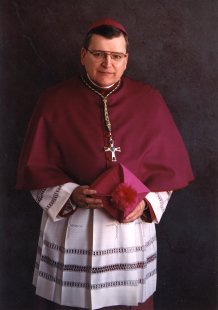
Funny thing about the Catholic Church: When she really wants to give someone a reward, or an honor, or some kind of recognition, she doesn't spend much time on medals and ribbons, on parchment proclamations, or (perish the thought!) a cozy research grant. No, when the Catholic Church really wants to honor a man of extraordinary talent and dedication, she gives him—another job to do. That's how I see the recent appointment of St. Louis' Archbishop Raymond Burke as a member to the Apostolic Signatura (the Church's highest administrative law court, 1983 CIC 1445). Abp. Burke knows that offices in the Church are given for the sake of service, and that when the Church calls one to higher and additional offices, she is really calling one to serve the People of God even more deeply than before. Prayers and best wishes, Archbishop Raymond Burke! Some interesting analysis on this appointment from reporter Tom Szyszkiewicz.
Excommunication for deliberate embryo destruction?
Alfonso Cardinal Lopez Trujillo, the outspoken president of the Pontifical Council on the Family, has asserted that "destroying human embryos is equivalent to abortion"; therefore, he says, those directly involved in such deeds are liable to the canonical penalty established for abortion, namely, excommunication (1983 CIC 1398). That the cardinal stands on solid biological and moral grounds in equating deliberate embryo destruction with procured abortion is beyond serious question. What I want to ask is whether he stands on solid canonical grounds as well. Consider: until the last few decades, all canonical discussions of abortion were concerned with actions occurring, obviously, within the womb. The recent development of extra-uterine fertilization technologies, however, including cryogenic storage of embryonic human beings, has created a group of humans at peril for their lives, but who, given the canonical maxim that penal laws are subject to narrow interpretation (1983 CIC 18), might fall outside the scope of the traditional abortion canon. So, one must ask: is the deliberate destruction of an embryonic human being outside the womb the canonical equivalent of an abortion procured within it? Cardinal Lopez Trujillo believes that it is, and I think he's right. How? Back in the late 1980's, again in the wake of bio-medical developments, the question arose whether very early abortions caused by the IUD, RU486, and certain contraceptives, were encompassed by the abortion canon which, as canonists knew, envisioned later-term procedures. On 23 May 1988, the Pontifical Council for the Interpretation of Legislative Texts addressed the following question: "Whether abortion, as treated in canon 1398, should be understood as only the expulsion of an immature fetus, or whether it is also the killing of a fetus accomplished in any manner and at any time from the moment of conception?" The pontifical council ruled for the wider definition (AAS 80 [1988] 1818-1819), and eminent canonists such as Fr. Joseph Fox, op, explained then that the interpretation kept the canonical understanding of abortion medically up to date and morally consistent with the respect owed to innocent human beings regardless of the technique by which they were being killed during their first months of life. But notice: nothing in the 1988 authentic interpretation limits the understanding of abortion to actions occurring in the womb; indeed, the interpretation clearly asserts that any killing of a fetus, accomplished in any manner at any time after conception, is canonically an abortion for purposes of Canon 1398. Now, I don't want to put words in the cardinal's mouth, and it is possible that he has other arguments by which to defend his position, but it seems to me that, in asserting that those involved in deliberate embryo destruction are liable to excommunication for abortion, the cardinal, while not authorized to issue binding interpretations of canon law, has simply connected the dots left by offices that do have that authority. At a minimum, I think those disagreeing with Cardinal Lopez Trujillo have the burden of showing why deliberate embryo destruction is not, in light of the 1988 interpretation, a type of abortion punishable by excommunication. There are, of course, more issues raised by the cardinal's interview than I can discuss here. But for now, I observe only that Cardinal Lopez Trujillo remains one of the most consistently incisive and plain-talking members of the Roman Curia, and that's good news for our side. Note: As it happens, the Ave Maria School of Law in Ann Arbor MI is dedicating an entire issue of its excellent law review to the legal and philosophical thought of--you guessed it--Cardinal Lopez Trujillo. A host of fine scholars will be responding to an original essay by the cardinal which appears in that same issue, and it all begins with an introductory essay provided by yours truly. Look for it soon! Pertinent follow-ups: John Allen; Chronicles of Higher Education; Amy Welborn; Jimmy Akin; Sandro Magister.
Msgr. Cormac Burke is an Irish priest of the prelature Opus Dei, a member of the Irish bar, professor of modern languages, and a prolific theological author. More than all of these, though, Msgr. Burke is one of the world's most influential English-speaking canon lawyers, serving 13 years on the Roman Rota as an "auditor" (essentially, a judge), retiring in 1999, only to continue his priestly service by teaching in Kenya. Msgr. Burke is that unusual kind of man who has maintained extensive scholarly output while performing Church work at the highest levels; in him, we have the chance to see how a canonical judge (one with a common law formation at that) adjudicates actual cases, and how the same man reflects on those issues as an academic. Thus, his decision to launch a personal website, featuring many of his books, articles, and judicial sentences, is very exciting news. His materials (often entire works) are now available in several languages. Note that in earlier centuries, retired Rotal judges would often publish collections of their sentences for the edification of those to follow. Ius novissimumcanonists such as Cavalerius, Herrera, and Otthobono come to mind here. But with the codification of canon law in the early twentieth-century, this practice seems to have fallen off. It's been 50 years since Charles Holbock, a Rotal advocate, published his personal guide to Rotal jurisprudence, the Tractatus de Jurisprudentia Sacrae Romanae Rotae. So, by making his Rotal sentences available electronically, Msgr. Burke revives an invaluable practice, and helps bring the wisdom of canon law to bear more effectively on the issues of our time. Related interest: Click here for Dr. Peters' reading notes on papal addresses to the Roman Rota; click here for Dr. Peters' 1990 review of Burke's Authority and Freedom in the Church (1988).
The Congregation of the Doctrine of the Faith has invited Fr. Marcial Maciel Degollado, the founder of the Legionaries of Christ, to spend his remaining days in "prayer and penance, refraining from all public ministry". Given the enormity of the sexual abuse accusations made against Maciel and the apparent credibility of many of his accusers, this directive (an "invitation" from CDF being essentially indistinguishable from an order), stopping short of a trial and well short of a conviction (or, for that matter, exoneration), will strike some as an inadequate resolution of this case. Several obstacles stand in the way of a formal canonical trial in Maciel's case. First, such accusations, by their very nature, are difficult to prove (that being one of the most enraging aspects of this scandal); second, the long period of time since the alleged acts raises serious questions (usually under the rubric of statutes of limitations) about the prudence of attempting to adjudicate such cases at all; third, the juridic problems associated with the excessively long list of "affirmative defenses" that defendants can use to resist canonical penalties (chiefly in 1983 CIC 1323-1324) are very difficult to address during a trial; finally, in every prosecution of the elderly (Maciel is 86), prosecutors ask cui bono? Nevertheless, I think that the CDF directive that Maciel undertake prayerful "penance" might have greater canonical significance than meets the eye. Under common law, one is either found guilty of a crime in a trial, or not; thus, the possibility of, and significance of, canon law's alternative to a formal guilty verdict and sentence is easy to miss, especially since it (penance) sounds like something all the faithful are called to anyway (1983 CIC 1249). Canon 1312 § 3, setting out the basic categories of ecclesiastical sanctions, states "Penal remedies and penances are also used; the former especially to prevent delicts, the latter to substitute for or to increase a penalty." In other words, the same kinds of acts or omissions that could result in a canonical penalty can, for various reasons, result instead in what is called a "penance". The possibility that CDF's call here for penance is its response to canonical crime(s) increases when one notes that 1983 CIC 1339-1340 authorize penances for those "upon whom, after investigation, grave suspicion of having committed a delict has fallen." Nothing here proves the accusations against Maciel, which he has repeatedly denied; nor does it force the conclusion that CDF believes the accusations; in fact, we do not even know whether CDF is using the word "penance" with a sanctions-connotation. As American lawyers would say, there is wiggle-room in the statement, and it is possible that today we see Maciel joining the sad list of holy men and women who, over the centuries, have been vilified by the world and mistreated by ecclesiastical authority. On the other hand, Rome is not in the habit of publicly telling successful, high-profile Church leaders to go off and spend their lives in private penance. It is possible that CDF examined the Maciel case, found within it evidence of grave misconduct yet, like the farmer who discovered weeds growing amid the wheat (Matt XIII), decided that uprooting the evil now would harm the innocent; if so, it seems, CDF has directed Maciel to especially prepare, trusting in the infinite mercy of Christ, for the day when every deed, and every aspect of every deed, will be made plain to all.
In 2002, Brooklyn Bishop Thomas Daily refused to allow a funeral Mass for John "the Dapper Don" Gotti. At the time I thought, "That makes sense; it sounds like a pretty straight-forward Canon 1184 matter." and went on to other things. Just last year, though, a civil lawyer published what purported to be an extensive canonical and theological criticism of Bp. Daily's decision: Patrick Gordon, "Gotti, Mob Funerals, and the Catholic Church", Journal of Catholic Legal Studies 44 (2005) 253-276. (Abstract here) When I saw the article, I turned to it with interest because I assumed it would deal competently with a legally and socially important topic. To my surprise and disappointment, however, the article was very poor. Gordon, using demonstrably shabby canonical analysis, visited severe criticism on a bishop who was acting squarely within the scope his authority. I decided a reply was in order. My defense of Bp. Daily's funeral decision, "Lest amateurs argue canon law: a reply to Patrick Gordon's brief against Bp. Thomas Daily", has just been published by the Pontifical University of St. Thomas Aquinas (Rome), in its review Angelicum86 (2006) 121-142. The article is now available on my website.
I had not intended to blog about canonical penalties, specifically 1983 CIC 1382 and its automatic excommunication, in my earlier remarks on the Communist ordinations, but the issue keeps coming up. Oh well, that often happens in a crisis; matters better left for discussion in calmer times are suddenly thrust into the limelight. Briefly, there are two very complex and controverted canonical issues raised here: (1) what is the place of automatic (latae sententiae) penalties in a legal system; and, (2) do Canons 1323-1324 render practically unenforceable most of Book VI, Part II, of the 1983 Code? I will not suggest an answer to either question in this blog; I'm just alerting to folks to where the questions are. In the case at hand, prescinding from several other worthy canonical defense arguments, 1983 CIC 1324 § 3 says that a latae sententiae penalty does not apply to one whose actions were coerced by grave fear (even if it is only grave in the perception of that person), even if the action tends to harm of souls. The Vatican's own statement asserts what others reasonably surmised: some of these men were coerced by Communist officials into acting as they did. Now, I like to think that laws mean what the words say; thus, I cannot think how automatic excommunications were incurred under these facts. But notice, the Vatican has not claimed otherwise. While Navarro-Valls' correctly referenced Canon 1382, he did not state that those involved in this case had incurred the sanction. He does not have that authority, and I frankly doubt that even the Vatican would have access yet to the kind of canonically relevant information necessary to form such a conclusion. Instead, the secular media has drawn that conclusion, though in this case it's hard to blame them for doing so. Canon 1382, the only norm cited by N-V, sure seems to support it. The sacramental questions raised by Communist ordinations still seem more interesting to me, but if this crisis occasions a fresh look at the legal problems associated with latae sententiae penalties and the affirmative defenses in Canons 1323 and 1324, so be it. Last thought: the more that factors such as external coercion tend to diminish penal liability, the more it seems that questions about sacramental validity can be raised; conversely, where there is less interference with freedom, the more likely it is that sacramental actions are valid and that penalties for illicit celebrations would apply.
Second thoughts on Communist episcopal ordinations
The excommunications consequent to the illicit episcopal ordinations (1983 CIC 1382) staged by Chinese Communists are so obvious that few commentators have mentioned them. Here I raise a different question: In the face of some sacraments being so obviously celebrated with no discernible pastoral sense and, in fact, driven by little besides a "let's stick it to the Catholic Church" animus, has the time come to step back and ask some hard questions about the canonical validity of such sacraments? I have suggested that the most theologically significant decision reached by CDF under Cdl. Ratzinger was its 2001 declaration that Mormon baptism is invalid, despite eligible ministers and recipients, and despite proper matter and form. Reopening a debate that seemed settled since the time of Sts. Augustine and Cyprian, Mormon baptisms are invalid apparently solely on the basis of intention, that fifth, and in many ways most elusive, of the factors impacting sacramental validity. Is it too much to wonder, then, whether Communist episcopal ordinations have crossed a similar line? Just what is a Communist's understanding of and intention in conferring, of all things, holy orders? Remember, until a few decades ago, similar questions on Mormon baptism seemed unthinkable, and until a few years ago, everyone assumed they knew the answer. Updates: May 4. Navarrao-Valls' statement. The comment about bishops and priests being "greatly pressured and threatened" ( I can imagine) to take part in the ordinations raises fresh concerns, I suggest, about their validity. See 1983 CIC 125, etc. Note: The bases upon which one can raise validity questions about Communist episcopal ordinations without raising similar questions on, say, SSPX episcopal ordinations, are contained in the above post, but I don't like to spend time underscoring the already-obvious. Analogy: Two Catholics free to marry, but under ecclesiastical precept not to marry each other (1983 CIC 1077), and neither of them wanting to marry the other, are forced by government officials to go through a wedding ceremony together. Any guesses as to how many ways such a sacramental "marriage" could be declared null? Can a similar analysis be applied to ordination, pace contract issues? Related issue. The problematic nature of latae sententiae (or, automatic) excommunications is highlighted in this case. Navarro-Valls recites both the canon imposing the excommunication and numerous factors that would prevent the penalty from being imposed in this case (see 1983 CIC 1323-1324). That is different topic, however, except to mention that, in this case, the factors which mitigate one's culpability for crime seem similar to some that impact one's intentionality for sacramental celebration. Secular media reports about the Vatican having excommunicated those involved cite to N-V's statement which statement, however, standing alone, would be insufficient to declare the incurrence of a penalty in a particular case (1983 CIC 1341). Jimmy Akin's thoughts on all of this here and Jimmy Akin's additional thoughts here. Updates. May 10: 1) Tom Szyszkiewicz thoughts here. 2. ZENIT report of a decree from CDF (11 Feb. 2000) expressing concerns about validity of certain presbyteral and episcopal ordinations carried out under Communist persecution in the Czech Republic. The decree does not state what the concerns were, only that they should be resovled by ordination sub-conditione (see 1983 CIC 845).
Canon Law Discussions. Praecipue ad usum scholarum. I. The Formal Act of Defection. 1. It is possible (c. 124), but highly unusual, to impose, for validity, on "rank-and-file" members of the Church, the specific obligation of writing when they wish to achieve an effect in the Church. Indeed, outside of a few cases involving higher-level ecclesiastical administration, it appears that a writing requirement for the validity of an action is virtually unheard of. Rest of post continued off-blog.
Of those matters we know anything about (an important qualification when discussing papal activities), Benedict XVI's letter to the Congregation for the Causes of Saints seems to me to be one of the most important things he's done to date. It certainly shows the clearest difference between him and John Paul II to emerge so far. Benedict XVI could have communicated his concerns about the beatification and canonization process in a simple telephone call; instead he wrote a short treatise on the topic. The world was meant to take notice. John Paul II, both legally and by force of his personality, improved the Church's ability to recognize contemporary examples of holiness. But, by canonizing over 450 saints (more than all the popes since Trent combined) and by beatifying more than 1,300 men and women besides, John Paul's vital message that the "universal call to holiness" (Lumen gentium V) could be lived in modern times was (in the opinion of many) being steadily diluted by an avalanche of names that, with few exceptions, would never be recognized beyond small circles of compatriots. Moreover, most of the examples of those living the universal call to holiness seemed less than universal: while they came from many places around the world, the vast majority of canonizations and beatifications under John Paul II were of clergy and religious; of those laity lifted to the altars, almost all of them were martyrs. But how many examples of how to be a good nun, even in the twentieth century, does one need? Is there really, for all practical purposes, no way for laity to become saints except by martyrdom? Beyond these pastoral questions, Benedict XVI's letter also communicates some important theological points. I'll mention just one: martyrdom must be carefully distinguished from other instances of religious persecution and murder, even those committed against Christians, by this crucial fact: a martyr accepts death delivered out of hatred for the Faith. A drive-by shooting victim, shot outside of a church because the killer hates Catholics, is not a martyr (for lack of acceptance of the death by the unaware victim). A Catholic priest thrown into a concentration camp because he is a priest, is a victim of religious hatred, but not a martyr (for lack of the witness ending in death). A pious Catholic girl who flees soldiers intent on raping the women of a village, during which flight she is shot, is not a martyr (for lack of the soldier's hatred of the Faith). Yes, we all know there are a few close cases such as Maximilian Kolbe and Gianna Beretta Molla; a blog is not the place to analyze them. Moreover, note that each of the above examples might well describe a saint (if not a martyr). Finally, bear in mind that once the Church canonizes someone, we have the assurance that they are now with God in Paradise--no matter what procedural rules were being applied at the time. Nevertheless, Benedict XVI's letter to the Congregation enables us to ask some probing questions about the canonization and beatification process without appearing disrespectful of the worthy goals that John Paul II was, by his lights, trying to serve.
Wow. Regular readers know that I don't do book or magazine promos in my blog, but the current issue of Homiletic and Pastoral Reviewis too good to let pass without comment. To highlight just a few items: Rev. Mark Pilon, though not a canonist, offers a canonically sound look at the advantages that might accrue if we started leaving pastors in parishes for more than a few years at a time. Msgr. John Burke brings out catechetical imperatives in the New Evangelization (a topic very dear to us here at Sacred Heart Major Seminary), and the redoubtable Fr. Anthony Zimmerman helps us unpack pastoral issues raised by the 1997 Vademecum for Confessors regarding contraception. Passing over Dominican Fr. Girard's homilies (I'm just a layman, so what do I know about preaching?) and Nancy Cross' critique of the New American Bible (I'm a cradle Catholic, so what do I know about the Bible?), Mary Gillman (a former graduate student of yours truly) writes a trenchant expose of the latent anti-Catholicism behind the perennial attacks on Pius XII in regard to the Holocaust, and there's an engaging reply by Chuff and Kathenborn to an earlier HPR article on the ordination of homosexuals (confirming that the really interesting debates occur within orthodoxy, not outside of it). All Detroit-area Catholics know about the "Grotto", but others might enjoy automotive engineer (!) Diane Korzeniewski's personal, but not idiosyncratic, look at the liturgies celebrated at Assumption Parish. There's an in-depth book review of a new text on the Catholic Church and economics (outside of my area, but I'm glad we have people on this) and several other useful notices, including a very helpful look at the recent release of St. Raymond's Summa on Marriage in English and a short overview by Fr. Leonard Kennedy (csb) of Judge John Noonan's controversial exploration of (alleged?) changes in Catholic moral teaching. Fr. Baker's editorial is a combination report/analysis on the 2005 Synod as it impacts the clergy shortage. The QA column (rats!) and "My Favorite Priest" are missing, but the space saved thereby this month was obviously devoted to some of the solid articles and reviews above. If only for breadth of topics, not to mention fidelity of treatment, the April 2006 HPR is going to be one tough act to follow.
Some thoughts on the conviction of Fr. Donald McGuire
A few weeks ago, Fr. Donald McGuire, SJ, age 75, was convicted on five counts of indecent acts with a minor. The accusations, dating back nearly 40 years, were made by two men using a quirk of Wisconsin law whereby, it seems, some statutes of limitations do not run against non-Wisconsin citizens. But, however we got to this point, Fr. McGuire's situation raises some difficult questions for the rest of us. Consider: either Fr. McGuire committed these acts, or he didn't. If Fr. McGuire did not commit these acts, we have a textbook illustration of why statutes of limitations are vital: the innocent have a much harder time defending themselves against older accusations than against newer, especially when the wider community is awash with examples of similar accusations being independently confirmed or admitted. We also see a serious gap in 1983 CIC 1390, which treats false accusations and testimony against a priest in civil courts as, at most, simply another kind of "injury to the good reputation of another", a description that scarcely does justice to the viciousness of this particular form of injury to a reputation. But if Fr. McGuire did commit these acts, we confront an even deeper reality: we see, do we not?, how Christ, Who makes all things new (Rev. 21:5), can draw immense good even from people who have done evil things. I knew Fr. McGuire briefly in the mid 1980s when he was a portrait of priestly piety and good sense in the cesspool that was Hollywood. About that time, moreover, Mother Teresa, no mean judge of men, had selected Fr. McGuire as one of the very, very few priests whom she would allow to give spiritual direction to her sisters. So, if his accusers are telling the truth (something we willall know with certainty on the Last Day, CCC 1038-1040), then it seems that Fr. McGuire had, by the time I knew him 15 years later, drawn deeply on the graces that Christ continually offers us all--in this case, to go from sexual miscreant to profound instrument of God's love. All I can say to that is, there must truly be hope for any of us. I don't know which scenario is true, and I've learned that opining about the truth in these kinds of cases is pointless, or worse. But can we not say at least this much: If Fr. McGuire goes to prison for crimes he did not commit, he certainly (a) won't be the first priest in Church history to do so, and (b) will minister faithfully to whomever he meets. And if Fr. McGuire goes to prison for crimes he did commit, he (a) will doubtless apply his suffering under this world's rough justice against whatever he might owe before God's terrible tribunal, and (b) will minister faithfully to whomever he meets. Either way, I want to be in his prayers. Update July 29: Fr. McGuire has been sentenced to seven years in prison and a long period of probation. His conviction is under appeal. His commented at his sentencing "Your Honor, you are looking at an innocent man, innocent of the heinous crimes of which I was accused."
If you read only one essay on the injustice being perpetrated against the Catholic Church by certain states rolling back their statutes of limitations in cases of alleged clergy sexual abuse, read Bp. Charles Chaput, "Suing the Church" in First Things (May 2006) 13-14. It's devastating. And he's not even a lawyer. I have long argued that the statutes of limitations in canonical criminal cases (see 1983 CIC 1362-1363) were too short, but I have never supported changing them to enable prosecution of past canonical crimes; too many innocent people are required to defend themselves under circumstances where their ability to do so is seriously weakened. By the way, those who manage to hide their crimes until a statute of limitations has run do not escape punishment. They merely transfer it to a realm wherein mercy has no power to mitigate justice.
The Pontifical Commission for Legislative Texts has just issued a "Notification" that makes it more difficult to conclude that a given person has "defected by a formal act" from the Catholic Church. The Notification raises some thorny questions for canonists which need to be, and will be, addressed elsewhere; here, I only point to a strength in the Notification that rank-and-file Catholics are likely to overlook. The Notification (para. 2) rejects an understanding of "formal defection" that would accept as proof of formal defection those curious documents that dioceses around the world get from time to time (in my experience, they were all from Germany) whereby the local bishop is duly informed that so-and-so, baptized in his diocese, has renounced before a government official his or her Catholic identity--and thereby gets a religious tax break. St. Paul, I suspect, will have some rather strict things to say to such folks on Judgment Day, but personally I hesitated to read these documents as anything more than money-saving schemes filled out by lazy and/or badly catechized Catholics. That hunch (and I think it was widely shared) now seems verified by the Pontifical Commission, which clearly views formal defection from the Church as an action much closer in character to apostasy, heresy, or schism, than one comparable to a "fill-out-the-form-and-save-a-few-euros" gimmick. I think that's good. Some other important issues raised by the Notification are best discussed elsewhere, but perhaps one more quick observation is in order: Because it is now clearly harder to prove that a given Catholic has defected formally from ecclesiastical communion, that means that the number of Catholics still bound by the requirement of canonical form (1983 CIC 1108 and 1117) for marriage is higher than some might have thought, which in turn means that more "marriages outside the Church" can be found null for violating canonical form. My impression is that US tribunals had already adopted a narrow reading of "formal defection" to begin with, so the actual impact of this Notification on raw numbers in US marriage cases will be small, but to the degree the Notification has any effect in this area, it would be to increase, not decrease, the number of annulments. April 18: Jimmy Akin points out some practical problems associated with this surprising interpretation of the law. Here's another question: Catholics have a "proper pastor" in their bishop (1983 CIC 369) and in their parish priest (1983 CIC 515 § 1). It is not clear to me, then, how at least two distinct men, who obviously need not agree in their reading of the facts in a specific case, are simultaneously "uniquely qualified" to decide whether a given act counts as a "formal defection" (Notif. para. 5). Moreover, the use of the word "Ordinary" in para. 5 still has the feel of "diocesan bishop" about it, despite 1983 CIC 134 underscoring that when canon law means bishop, it will say "bishop". As I suggested above, there are several other questions occasioned by this Notification, and time will doubtless help us sort them out. In the meantime, here's one for the dogmaticians: Is the phrase "Semel baptizatus, semper baptizatus" (which the Notif. para. 7 clearly and correctly upholds) identical in meaning to "Semel Catholicus, semper Catholicus"?; and another for the Church historians: "Would most (indeed, would any?) of the 16th-century Reformers have been considered to have "formally defected" from the Church under this interpretation? April 27: Further discussion off-blog.
Back in Lent of 2003, Bp. John Botean, Romanian Catholic Eparch of Saint George in Canton OH, issued a startlingly specific condemnation of Catholic participation in the Iraq War. I thought then, and still think, that such a statement could not simply be issued and forgotten. The eparch's letter raised too many important issues for that to be its fate. I blogged to this effect on March 18, 2003 (updated March 20) calling attention to, and expressing serious reservations about, Bp. Botean's statement. Unfortunately, it appears that his letter, despite provoking serious questions on the use of canonical and moral authority, has been--at least at the hierarchical level--ignored. Some time later, John Sharpe began assembling an impressive array of thinkers opposed to the Iraq War and, for obvious reasons, included Bp. Botean's letter in his collection. Despite my clear reservations about Bp. Botean's comments, Sharpe contacted me and asked permission to include my critique of Bp. Botean's comments in the book he edited, Neo-Conned! Just War Principles: a Condemnation of the War in Iraq (HIS Press, 2005). Happy to cooperate with those trying to make a serious contribution to public discourse, notwithstanding my disagreement with some of their positions, I gave that permission, and my essay on Bp. Botean's letter appears in Neo-Conned. Since then, various promotional notices of Neo-Conned and some early (perhaps necessarily superficial) reviews of the book have, quite correctly, listed me as a contributor to Neo-Conned, but in a way that makes me feel like an usurper of the praise that those who agree with the book's major premise want to give its contributors, while simultaneously being presumed guilty by those opposed to the book's argument in that I published in Neo-Conned. Oh well, over time people will read Neo-Conned itself and form their own conclusions about what I did, and didn't, write. Having said this much, though, and for what it might be worth, on the Iraq War I fall, if anywhere, in a very narrow no-man's-land. I say "if anywhere" because I have not really "taken a position" (whatever that exactly means) on the war for the simple reason that ordinary citizens (and I am unusually ordinary) generally do not have the information necessary to form persuasive opinions on such matters. Specifically, I think that Just War principles are primarily intended to inform governmental leaders in their decision-making (CCC 2309); the criteria by which we citizens relate to the government are distinguishable in a number of respects. In any case, here in no-man's-land, we happy few think that a plausible case can be made for the United States to have invaded Iraq to rid that people of their mass-murdering, war-mongering, terrorist-abetting, eco-terrorist dictator Saddam Hussein, but that our staying there to try to establish a parliamentary democracy in a land with no 'democratic infra-structure' is, well, less plausible. I admit to being surprised that this reasoning finds so little resonance with others; it makes me wonder whether I/we have missed something important, but, there it is. In any case, my comments about Bp. Botean, on my blog and in Neo-Conned, are only about the eparch's canonical and moral reasoning, on which topics I have some special qualifications to speak, and not about US participation in the Iraq War, on which matter I have no special qualifications with which to opine. April 11: To my knowledge, Mark Brumley's criticism of Bp. Botean's letter has never been answered either.
April 4. The discussion of this issue grew rapidly, and so I'm going to be moving it over to my CanonLaw.Info website later. In the meantime, a very thoughtful letter arrived from a seminarian asking questions about this case in a way that seemed to warrant answering from a seminary professor (albeit at a different institution). On the chance that his questions and my answers would be interest others, I am posting them (edited down).Dr. Peters, I am a seminarian and am very interested in Canon Law. I believe that in its proper application there is much wisdom contained. Amen to that. Bp. Bruskewitz says in his release that the "Diocese of Lincoln is and has always been in full compliance with all laws of the Catholic Church." I assume that Bp. Bruskewitz knows that the charter has been given the force of particular law in the USA. Careful here, you're confusing the Charter with the Essential Norms. I made the same careless confusion myself in my earliest posts (see below), so I know how easy it is to do. Ironically, even some of Bp. Bruskewitz's abler advocates have called both the Norms and Charter "particular law" (although I do not think the bishop ever confused them), so there is (or was) apparently plenty of misspeaking on this. In any case, we all (including me!) should be clear: only the Norms qualify as particular law, not the Charter. Could he be asserting that he does not believe that the charter can be enforced? The "enforceability of law" is a complex issue but, while interesting, I don't think it is raised by these facts. You see, everyone agrees that Norms are law, most bishops recognize at least some degree of appropriateness in the Charter, and even Bp. Bruskewitz has said that if the Charter became law, he would abide by it. So enforceability per se is not an issue. I understand Bp. Bruskewitz to be saying that the Norms are law (which they are) and that he has followed them (the verification of his assertion being a separate matter). He says that the Charter is not law (which it is not) and therefore he does not even have to recognize its existence or that of the USCCB's National Review Board (which is a different and debatable assertion). The National Review Board and other agencies established by the charter by their nature interfere in the divine right of bishops to govern (ref. Letter from Dr. Ewers "Though their governance authority is fully understood by the Board"). I think I know what you're saying here, but I doubt anything "by its nature" interferes with the divine right of bishops to govern. Some things in practice might cause interference, and that needs to be looked at (as we do below). But Dr. Ewer's letter does not concede that the NRB to which she has been appointed "by its nature" interferes with legitimate episcopal authority. Indeed, as I noted below, this audit-survey was clearly authorized by the USCCB, which authorization included a direction to publish the names of those not in compliance with the Charter. But as to whether that authorization could then be parlayed into authorization to call for bishop's "fraternal correcton", and whether such a call would justify in turn the kind of response it received from Bp. Bruskewitz, well, surely reasonable minds may differ. The National Review Board and other agencies would represent a separate authority in his diocese making the Bishop answerable to another group in his governance other than God and the Holy See. Depending on what we mean here, this answer could go a few different ways. But first, it is not true that a bishop is answerable only to the Holy See in the governance of his diocese. You will learn in courses on diocesan structures and supra-diocesan structures that bishops must be responsive, for example, to civil law in a whole host of matters (begin with 1983 CIC 22), to episcopal conference authority over some 40-80 canons, to metropolitans and patriarchs in a few areas (and historically, suffragan bishops were subject to intermediary prelates in many respects), and even to some local ecclesiastical bodies such as the diocesan finance council and the college of consultors (see, e.g, 1983 CIC 1277). Even the notion that bishops respond to the "Holy See" can be misleading insofar as it assumes that the "Holy See" speaks to bishops with one mind and one voice in clear and consistent terms. In brief, the perception held by some that there is only a bishop-straight-to-the-pope authority structure in the Church is an over-simplification of reality, and is not supported by law or history. About your comparison of two kinds of reports, ad limina versus National Review Board, what are the theological and ecclesiological reasons that would allow the USCCB or the NRB to demand anything of a diocesan bishop as opposed to the Holy See. I think we've addressed that above, no? If not, keep reading! But there is still a question here. Everyone agrees that the Norms are law, and that the Norms require bishops to undertake certain independently verifiable actions. What is not clear (to me anyway) is whether the audit, conducted under the aegis of the Charter (following an admittedly overly complex schematic of offices and mandates), which audit was refused by Bp. Bruskewitz, is the USCCB's mechanism by which a bishop's compliance with the Norms is verified. If it is, then would not a bishop's refusal to respond to the audit, at least in regard to questions concerning the Norms (and I showed below some examples of where that happens), amount to a refusal to offer verification of his compliance with the Norms? I phrase this as a question, since it possible that Bp. Bruskewitz has offered verification of his compliance with the Norms in some other way. The USCCB would know whether Bp. Bruskewitz has complied with all the Norms. The Holy Father by reason of his office as universal pastor can demand things, Yes, of course, as per 1983 CIC 331 but the USCCB does not have an office as such. Well, but the USCCB does have authority to bind member bishops in certain matters, as I said, in that the 1983 Code gives it authority in roughly 40-80 areas of canonical and pastoral concern. Also, with the Holy See's approval, an episcopal conference can make additional demands on diocesan bishops under 1983 CIC 455, and that is what happened in regard to the Norms. Note that the Holy See's approval of the USCCB Norms does not turn conference legislation into papal legislation. It remains conference legislation; that's why we call it "particular" (as opposed to "universal") law. I understand that the charter [Norms] has become particular law in the United States, but what is the ordering if another law of the church is contrary to the particular law? The general rule is, of course, that law emanating from lower authorities that is in conflict with law emanating from higher authority must yield to that higher law. Can a person point to internal contradictions in the law and say which governs? Again, it depends on what one means by "say". I might well think that a lower law being imposed on me conflicts with a higher law, but I probably do not have the right to exempt myself from the lower law while I take my case to higher authority. (Leave aside hard cases where something gravely contrary to natural law is being commanded.) Besides, I might be sincerely but seriously mistaken in my reading of the lower law, or I might be partly right and partly wrong. You can see that allowing each subject of a law to decide which laws apply to him or her would quickly lead to chaos. The present case makes this question basically moot, though, because the Charter is not law at all, and the "particular law" in the Norms has already been approved by the Holy See. Time will tell whether any of the drafting infelicities in the Norms need to be repaired, but it would be hard to argue that the Norms already approved by Rome constitute a grave interference with various canons on episcopal office approved by Rome. That's what the extended, pre-approval consultation back in 2002 was all about, heading off such conflicts. Dr. Peters, I appreciate your attention to my questions. I want to express in advance my gratitude any time you would be able to put toward advancing the education of a seminarian. Hey, that's what we're here for. Oremus pro invicem.
25 April 2006 NewsLink: Diocese in national spotlight over sex abuse audit ----FROM HERE ON DOWN, THE POSTS APPEAR CHRONOLOGICALLY, FROM FIRST TO LAST. I'M LEAVING THEM UP AS FIRST APPEARED, MY OWN MISTAKES INCLUDED, TO LET PEOPLE SEE HOW THE ISSUES EMERGED AND, I HOPE, EVENTUALLY IDENTIFIED THE CORE QUESTIONS AND THE SALIENT RULES TO BE APPLIED.---- I should have known we'd never fit this all into one blog entry. Below are really four entries, I, II, III, IV. PART I Diocese of Lincoln Bishop Fabian Bruskewitz has issued a scorching repudiation of the USCCB's National Review Board Chair Patricia O'Donnell Ewers' call for the "strong fraternal correction" of Bp. Bruskewitz (scroll to pp. vii-viii) and the Eparch of Newton for Melkite Catholics, the two American prelates who have declined to cooperate with the USCCB's Charter for the Protection of Children and Young People. Bp. Bruskewitz writes, "The Diocese of Lincoln has nothing to be corrected for, since the Diocese of Lincoln is and has always been in full compliance with all laws of the Catholic Church and with all civil laws." I hope that's true. But I am having trouble reconciling his claim with the law. Bp. Bruskewitz is a dynamic leader who loves the diocese committed to his care and the Church universal. I think that I am as zealous for the ecclesiological prerogatives of a diocesan bishop facing a huge episcopal conference and its lay staff as anyone who is not a bishop himself can be. Nevertheless, some serious questions about a bishop's duties under universal and particular law are being raised here. The USCCB's Charter is not simply a list of good, or least not bad, suggestions. Whatever weaknesses there still are in the Charter--and surely there are some--the fact remains, it constitutes what canon law calls "particular law" (1983 CIC 455) for the United States. It was approved overwhelmingly in 2002 by the US bishops and then by Rome (specifically the Congregation for Bishops, albeit after extensive discussions); it was reissued in 2005. As "particular law", the Charter is binding on all the bishops in the US, not just on those who voted for it, and not just in regard to those parts with which a bishop agrees. No one seriously thinks that the Diocese of Lincoln is trying to hide anything here. But Bp. Bruskewitz's statement goes beyond expressing refusal to implement the Charter (at least those several parts that are not already required by Nebraska law or the 1983 Code of Canon Law). It goes beyond refusing cooperation with the annual self-audit that was mandated by the Charter (the results of which occasioned O'Donnell Ewer's remarks). Bp. Bruskewitz is plainly rejecting the legitimacy of the USCCB Review Board itself and the policies it is mandated to coordinate. Regretfully, I don't see how else to put this: Bp. Bruskewitz is defying legislation that was legitimately passed by the episcopal conference and which received Rome's considered and express approval. And I think that's a problem. Salvo sapientiorum iudicio. On the revision of the earlier version of the 2002 Charter, see my Canon Law Blog (scroll to 5 November 2002). PART II Three quick questions, one more significant one, and a thought. Is Bp. Bruskewitz the first bishop who needs "correction"? What about bishops X and Y and Z? I think a number of bishops deserve, at the least, "fraternal correction" in regard to one or more aspects of the clergy sexual abuse crisis, but I have no special insight as to who deserves it first, or more, etc. What about the bishop's charges of bias on the part of the Board? Many people have expressed misgivings about some of the persons serving on the Board. That is a fair, but separate, question from whether they hold legitimate offices and have real authorization to undertake certain acts. We often make the same distinction (that is, between the person holding the office and the office being held) when we discuss bishops. What do you think of the tone of his letter? People can assess that for themselves. Lawyers have no special expertise on the tone of letters. Are audits required under the Charter? The audit (a term I do not like) that Bp. Bruskewitz has refused comply with is expressly authorized by 2005 version of Charter (Art. 9). It follows two previous audits conducted under, but not expressly called for, under the 2002 version of the Charter. Implicitly under the 2002 Charter, and explicitly under the 2005 Charter, the USCCB has established norms for the conduct for bishops and has authorized a particular body to investigate and report on the compliance of bishops with those norms. Bp. Bruskewitz refuses cooperation with that verification process, rendering nugatory the attempt to verify compliance with the law. Unfortunately, Bp. Bruskewitz did not limit his response merely to refusing cooperation with the audit process. He has asserted, among other things, that Board has no legal standing in the Church, that its Chair has no authority of any sort, and that he recognizes no requirements to act beyond the requirements already found in civil and canon law. There are, however, a number of provisions in the Charter that are not found in canon or civil law, such as appointing diocesan review boards, running safe environment programs, having printed procedures for making abuse allegations, and publicizing policies. Bp. Bruskewitz seems to be rejecting all of these provisions--even those of very easily demonstrated compliance. A thought. If Bp. Bruskewitz, who arguably "needs" the Charter less than most other bishops in the country, is concerned that it is the thin wedge by which a serious encroachment into episcopal authority is being made, he should take his case to Rome, specifically, by asking for a dispensation from the Charter or an indult of exemption. He is a smart man with proven record of orthodoxy. He would certainly get fair hearing on such an important concern, have the chance to make his arguments calmly, and be able hear Rome's necessarily wider view of the situation. More to the point, he would avoid coming across as projecting an above-the-law mentality as do so many others. PART III A welcome admonition from a monsignor who thinks I have not clearly enough distinguished above between the "Norms" and the "Charter". There is indeed some equivocation out there on this (in part because the Norms and Charter seem to overlap on various substantive points, and it is not always clear as to which rubric a question is being raised under). The 2002 Norms were approved by the USCCB and Rome. The revised 2005 Norms have been approved by the USCCB and (apparently) sent to Rome for approval. Both of those sets of norms contain a number of provisions that go beyond civil law and the 1983 Code. The USCCB has the right and duty to verify that bishops are complying with the particular law of the Norms. The National Review Board, operating under the Charter, seems to be the way the USCCB wants to conduct that verification process. But the point is arguable. We need to recognize that the Norms and the Charter were drafted in the midst of a disgusting crisis that had festered far too long and was consequently being addressed under the glare of hostile media attention and the approaching catastrophe of litigation that was sometimes scarcely distinguishable from plunder. Not surprisingly, the Norms and the Charter (as I indicated above) suffer from drafting ambiguities, both substantive and procedural, and that those need to be clarified. But for now, Bp. Bruskewitz takes the position that nothing in the Charter needs to be clarified because it is not particular law, and therefore anything or anyone associated with it is irrelevant. What is there to clarify about a non-entity? But are the Charter and the National Review Board really non-entities, or are they the (perhaps inadequately defined) mechanisms by which the USCCB verifies compliance with the Norms of particular law? And in any case, what in Bp. Bruskewitz's statement above indicates how his compliance with the Norms is to be assessed--well, beyond accepting his word as a man of integrity? Every five years, in compliance with Canon 399, Bp. Bruskewitz sends to the Holy See a quinquennial report on the state of his diocese; doubtless there is cause for rejoicing when the Lincoln report arrives. A quinquennial report is a way that developed over the centuries to verify that things are going as they should and to spot areas that need improvement in local Churches. But I wonder whether the requirement for such reports was perfectly articulated when norms for them first appeared in the 18th century; I wonder whether there was some good ecclesiological back-and-forth (perhaps taking place behind closed doors) about why such reports were necessary, even appropriate. But over time, the law was clarified and the requirement was accepted. Perhaps Bp. Bruskewitz's strenuous objections to reporting to the USCCB about certain matters in his diocese will occasion clarifying the appropriateness, and even the necessity, of diocesan reporting on matters of extraordinary national interest in the future. PART IV April 2: I am reminded of the little town that only had one lawyer. Poor fellow almost starved for lack of business. Then a second lawyer moved to town, and they both made a nice living. You can read canonist Pete Vere's April 1 and April 2 comments, largely disagreeing with me, here. I agree with Pete's comments in several places. But, among other points: 1. Pete defends Bp. Bruskewitz's 2004 refusal to reply to the John Jay Survey, but of course the John Jay survey is different from the audit authorized by the 2005 Charter. By my count, there are at least five offices and/or tools (National Review Board, Office of Child Youth and Protection, Gavin Group, CARA, and John Jay College) conducting USCCB-sanctioned surveys, studies, compliance audits, etc. That's crazy; no wonder if a bishop feels he's had enough of such overlapping inquiries. The JJC survey seems the least obligatory of them all. Anyway, because a bishop needs no reason to decline participating in it, we needn't debate the ones Bp. Bruskewitz gave. So, on to the Office of Child Youth and Protection audit that occasioned the present debate: 2. Pete quotes only the first paragraph (of three) in Article 9 of the 2005 Norms to demonstrate the advisory role of Office of Child Youth and Protection. The paragraph he quotes supports his argument. But in support of my claim that the audit they conducted was authorized, as was their publishing the results, I cited (above) to all of Article 9. Now, the second paragraph of Article 9 states: "The [OCYP] Office is to produce an annual public report on the progress made in implementing and maintaining the standards in this Charter. The report is to be based on an annual audit process whose method, scope, and cost are to be approved by the Administrative Committee on the recommendation of the Committee for the Protection of Children and Young People. This public report is to include the names of those dioceses/eparchies which the audit shows are not in compliance with the provisions and expectations of the Charter." It is on the basis of this second paragraph of Article 9 (not quoted by Pete) that I say the audit which Bp. Bruskewitz declines to answer was authorized by the USCCB, and that there was authorization to publish the results, including the negative ones. An episcopal conference does not need Rome's permission to ask its members questions or to publish the results. I recognize that this is a separate (though I think, still open) question from whether a bishop is required to answer a given audit. For that matter, I see no language (anywhere) that authorizes the Review Board Chair to publish a call for a bishop's "fraternal correction" for not participating in an audit, although the case for such an comment would begin with 1983 CIC 213. Also, USCCB President Bp. Skylstad apparently reviewed and General Secretary Msgr. Malloy approved the report for publication, including O'Donnell-Ewers' call. One should not read too much into such official awareness of O'Donnell-Ewers' position, but it does not appear that she blind-sided conference officials with her remark. 3. Finally, there still seems to be the basic question as to how Bp. Bruskewitz, who recognizes the obligatory character of the 2002 Norms, demonstrates his compliance with those requirements without replying to the audit. Compare, say, 2002 Norms 1-4 with Article 2 of the Charter, and you'll see how very much overlap there is between the Norms and the Charter in those areas. Has Bp. Bruskewitz satisfied the USCCB that he is in compliance with its Roman-approved particular law (i.e., the Norms, not the Charter) in this area in some other way? Perhaps so; individual canon lawyers have no special access to such information (that's one of several reasons why calls for us to take our concerns on this and other matters to, say, the Roman Rota are so silly; canon lawyers are not little attorneys general.) How to sum up? After decades of real or perceived inaction in the face of growing evidence of clergy sexual abuse of minors, the USCCB has recently reacted with a plethora of rapidly organized responses to reverse its real or perceived inattention. Notwithstanding some strengths, these efforts are, in my opinion, inadequately defined and poorly coordinated. Some of them are obligatory on bishops, some are optional; some are necessary or at least helpful, others are redundant, intrusive, or open to misuse. They all occasion genuine questions of conference vs. diocesan authority (the answers to which questions, all agree, have implications beyond that of the current abuse crisis). Controversies about major matters do not always surface in neat, refined, and polite ways, even in the Church. But we are, I trust, committed to finding the answers as quickly and as cordially as possible. I hope my own blogging on this has given those who need to make the decisions here some better awareness of the issues involved. Oh, and folks, don't ever let disagreement among canon lawyers worry you. Rudimentary familiarity with Church history, the last decade's, or the last millennium's, will find many more serious disagreements than this one! In any event, tomorrow's Monday, and it looks like this canon lawyer has raked in all the megabucks he's going to make on this file. It's time to go on the next big case. (Pete, do you know where we turn in our billable hours for this?)
posted by Dr. Edward Peters
Friday, March 31, 2006
The Lenten foot fight
At just over 1,100 words, my remarks on the annual controversy over who should have their feet washed on Holy Thursday came in a bit long for a blog (I try to keep blog entries under 500 words, pace my Bp. Bruskewitz blog, which morphed into five distinct entries and was sent over to my blog archives). My thoughts on the foot-washing controversy are posted if you're interested: "Our Lenten foot fight: it's time to resolve the mandatum rubric debate."
Let's assume that Tom Cruise and Katie Holmes are just two terribly catechized Catholics who don't have the faintest idea what it really means to be "married in the Church." That would explain how they (and the clueless media) could even be talking about their "being engaged" despite Tom's two previous putative marriages (c. 1085) and his apparent apostasy (cc. 751, 1071) to Scientology on the one hand, and the stress of Katie's metapublic pregnancy and her own dalliance with Scientology on the other. The point I wish to address, however, deals not so much with them, as with their baby, due shortly. As things stand now, their baby cannot be licitly baptized in the Catholic Church. No one disputes the importance of baptism (c. 849). G'ma and G'pa Holmes, reportedly pushing for baptism, have the right instincts here [Warning: lots of pop-ups!]. But Church law requires more than a hunch. Indeed, precisely because baptism is so important, canon law clearly rejects a "confer-it-under-any-circumstances" approach. In order for a baby to be licitly baptized in the Catholic Church, there must be what canon law calls "a founded hope that the child will be brought up in the Catholic religion." (c. 868). It is a common and defensible pastoral practice to delay the baptism of any baby born to Catholic parents not married in the Church which, last time I checked, described TomKat's status. But to that concern, one must add Tom's vociferous commitment to Scientology and Katie's obvious interest in it. If these facts don't add up to just cause for delaying the Catholic baptism of this child, then, nothing would. Obviously, this norm is not designed to punish a baby for something beyond its control, but rather, to impress upon Catholic parents the importance of what they and their child are undertaking, and to give some assurances that the child will have serious assistance as he or she grows into the fullness of Christian life. Admittedly, at some point, the child's right to baptism will outweigh the parents' duty to provide a Catholic upbringing, but that point is several years down the road at least. G'ma Holmes has been reported as saying that she will baptize the child herself. Well, unless her grandbaby is suddenly thrust into danger of death (cc. 861, 867) such an action would be gravely illicit on her part. Her conferral of baptism would probably be valid (c. 850), but it would still represent a disregard for a host of canons that emphasize parental duties and the proper role of ordained ministers for this crucial sacrament. Nor can G'ma claim hers was only a "temporary" baptism (till her daughter comes to her senses) or a "conditional" baptism designed to last until an "official" baptism could be conferred. I've heard both of these theories (and others) floated by grandparents distressed that their grandchild is being deprived of what they saw to it was offered to their own children. But, honest sympathies aside, that is not what law or sound sacramental theology hold. And yes, the rules on baptism are the same for everybody here, not just super-celebrities whose lives so often seem like textbook examples of how not to go through life.
Reports from the pre-consistory meeting of cardinals and the pope indicate that, among other topics, raising the retirement age for bishops was discussed. I don't see that there's much to discuss here. Canon 401 says that bishops "are requested" to resign their offices at age 75. Admittedly, a "request" from the pope (albeit in the form of a canon) is not lightly declined, but it's still not like canon law compels bishops to retire at 75. Indeed, the legislative history of 1983 CIC 401 shows a very clear ratcheting down of the "obligation" to resign. See Peters, Incrementa 364. Cardinals, moreover, retain the right to vote in papal conclaves until age 80 (UDG, Intro) and the recent practice has been for them to stay in their (arch)diocesan leadership positions until then; also, many cardinals in Vatican dicasteries stay in office well past 75 notwithstanding Canon 354 and ap. con. Pastor bonus art. 5, 2 (see, e.g., Current Eligible Electors). But the main reason we will see fewer arch/diocesan bishops retiring at 75 is practical: there is a serious shortage of good men, and a vacant see (USA / worldwide) is a bigger problem than is a see held by a man who is over 75. Doubtless, elderly bishops deserve to retire; privately, I imagine, many of them want to retire. But the Church cannot afford to let them go. The bishop crunch is in full swing, and it will be with us for quite some time. See E. Peters, "The coming bishop crunch" Homiletic & Pastoral Review (Nov. 1995) pp. 15-19. For these reasons, 1983 CIC 354 and 401 have become laws that are routinely ignored under circumstances where their enforcement would be easy. In this case, it is better, I think, simply to change the laws, rather than to cause more people to wonder what the force of exhortative canons really is in the 1983 Code. Update March 28: Karl Keating suggests some untapped sources for good bishops. Good ideas, as usual, from the founder of Catholic Answers. By the way, the "fresh approach" Karl suggests fits nicely with the idea I gently raised in the penultimate paragraph of my 1995 article. Great minds run alike, it seems.
I leave to abler minds a discussion of the advantages or disadvantages, if any, that the recent relinquishment of the title "Patriarch of the West" by Pope Benedict XVI will have in regard to ecumenical affairs. My thought concerns something different. Although endowed with no special jurisdictional authority, there are actually five patriarchates in the Roman Church: Jerusalem, Lisbon, Venice, the West Indies, and the East Indies (Johnson, CLSA New Comm 577). In addition, there are perhaps two dozen "primates" in traditionally Roman-rite countries, although they have little to no governing authority as such (1983 CIC 438). But the reductio ad obscuritatem that befell the western patriarchates (which were originally associated with their strategic locations as the New World was discovered) might have been a consequence of the fact that, when the pope himself is the patriarch in the west, what matters who else might have such a title? But therein lies the point: the pope no longer is the Patriarch of the West. Might this development over time (admittedly, likely measured in centuries) allow for a redevelopment of a functioning patriarchate system in the West? Perhaps Lisbon's day or Venice's has passed, but what about, say, Mexico City? or Chicago? or Manila? or even (let's really dream) Hong Kong? For that matter, might some currently quiescent primatial sees begin to exercise once again a real leadership role in their nations or regions? Or are we happy that there are no effective ecclesiastical structures between individual diocesan bishops and the Holy See, save for the bureaucracies of national episcopal conferences? Update March 23: See also Statement from the Pontifical Council for the Promotion of Christian Unity, and John Allen's perspicacious reports.
We've always known that there's nothing like real life to force the clarification of canonical and theological matters or, perhaps better in this case, to send one back to "the approved authors" for their answers to our questions. What is new is the ability of the blogosphere to ask questions in public that hitherto would have been (and perhaps should have been) researched more discreetly first. A few days ago, in tracking down some issues raised by the Phoenix Case (see immediately below), I came across a comment by the esteemed Nicholas Halligan, op, (Administration of the Sacraments) to the effect that unless the Sacred Species is/are swallowed, one does not "receive" the Eucharist; put another way, unless Communion (under either form) is taken into the stomach in the manner of food or drink, one has not received Our Lord. The implications of this interpretation, if it is correct, in the Phoenix Case would be obvious: the boy's manner of reception would not be sufficient to allow him to make Communion; but the implications for wider pastoral practices could be much greater. Two examples: (1) the administration of the Eucharist in the form of a drop of Wine to the moribund might not be administration of Communion to them after all; and, (2) the practice of tens of thousands of persons receiving the Eucharist under both forms at Sunday Mass--which such persons do in the minutest amounts in order to leave some for others--might not even be a reception [of the Precious Blood] if there is not enough actually taken in to swallow it to the stomach. In any case, I did not update my own post with this finding because Halligan gave no cites by which one could verify his assertion (even though he said his was the common view) and I am disinclined to raise disturbing questions without more research. But, I had not anticipated the arrival of "DB", posting over at Jimmy Akin's blog. (You'll need to scroll way down past some distressingly off-point comments.) DB has located support for (what I am presenting as) Halligan's thesis in Jone-Adleman, Prummer, Roberti's Dictionary, and even the Baltimore Catechism. All of those individuals are highly approved authors, meaning that Halligan's claim has some very good support. To be sure, more research has to be done before forming any definite conclusions here, and still other good questions are clearly being raised. But so far, these findings seem to lend more support to the bishop's decision that the manner of Eucharistic reception in this case was not acceptable, and should serve to remind all that simple questions often do not have simple answers. Update, March 15: Bp. Olmstead has just pointed out what the MSM certainly missed, namely, that he has not denied anyone Communion here; what he has done is to say that the practice attempted here is not Communion, and therefore cannot be continued. Click here for the story. More clear thinking, if you don't mind my saying so, from a canon lawyer bishop.
According to published reports, Bp. Olmstead of the Diocese of Phoenix has stated a 10-year-old, moderately-to-severely autistic boy should not be given Communion until it is demonstrated that the boy can receive the Host (which he apparently does reverently for some seconds) without then spitting it out (due to its texture which the boy's condition makes intolerable for him). Other shapes and sizes of Hosts have been tried without success, as has offering him the Eucharist under the appearance of Wine. Till now, the boy's father has been taking his son's Host and consuming it himself, an obviously loving act intended to facilitate his son's desire to receive Communion and preventing an immediate (objective) sacrilege to the Eucharist. A complex of canons builds a strong case in favor of reception of the Sacraments (1983 CIC 213, 843, and 912, to name some), and persons with special needs deserve extra efforts at accommodation (See, most recently in a considerable literature in this area, P. Vere, "Calling God's special children to holiness: sacramental access for the mentally and cognitively challenged", Canon Law Society of America Proceedings 66 [2004] 195-206). But a clear canonical preference for sacramental access, augmented by the accommodations that special needs persons deserve, does not amount to a "reception under any circumstances" rule. There are other important values that need to be considered here, and some of these necessarily guard against the profanation (intended or not) of the Eucharist. Both the parents and pastoral ministers in this case have, it seems, sincerely tried to find a way to let this boy receive the Eucharist and avoid profaning the Host. Still, the bishop, among whose duties is to monitor the celebration of the Eucharist in his territory (See, e.g., 1983 CIC 389, 392, and 838), has determined that those efforts were not successful. That is a reasonable conclusion within the scope of the bishop's authority. The situation is no one's fault, but it does mean that parents and parochial ministers will have to think of something else. In the meantime, no one should doubt the good will of anyone involved in this difficult case; and there is certainly no question but that Christ will help all find the right answer in time. Update, March 08: 1. Jimmy Akin, proffering no final answer here, has some theologically sound observations on the notion of "reception" of the Eucharist on his blog; 2) The Vere article cited above is similar to another available on-line, I. Burgess & P. Vere, "The canonical rights of God's special children", Homiletic and Pastoral Review (April 2003) 61-66; 3) a few people have opined that I obviously haven't the faintest idea of what it's like to raise a special needs child. To that may I say, my experience (if any) of raising special needs children is not relevant to my ability to explain the canonical issues raised in this case, but anyone with rudimentary research skills can easily determine whether such a characterization of me is accurate in the first place.
Reports are circulating that Pope Benedict XVI is exploring ways to bring the followers of Abp. Marcel Lefebvre (d. 1991) back into full communion with the Catholic Church; in other words, that the pope is doing one of the main things that popes are supposed to do, trying to heal divisions in the Mystical Body of Christ. But this process and its outcome are not completely under the control of Pope Benedict. In 1988, Abp. Lefebvre and four bishops he ordained were excommunicated by Pope John Paul II for violating 1983 CIC 1382. The resulting SSPX has never acknowledged the efficacy of this papal act and has called for the Holy See to repudiate the excommunication as a prerequisite for reconciliation talks. According to canon law, however, excommunication cannot be remitted unless the offender has "withdrawn from contumacy" (1983 CIC 1358 § 1). It is difficult to see how one can be considered to have "withdrawn from contumacy" (see 1983 CIC 1347 § 2) when one denies there is any contumacy to withdraw from in the first place. So, what to do? As I see it, there are only three options here: either the Holy See decides that John Paul II's decree of excommunication was insufficiently grounded in law and/or fact, and on that basis it lifts the penalty without addressing the merits of the situation today; or, the SSPX leadership somehow acknowledges its wrong-doing and repents sufficiently to allow lifting of the penalty under 1983 CIC 1358; or the SSPX remains fixed in its position and the excommunication remains in place while talks continue—or not, as the case may be. The first option has the proverbial snowball's chance of ever happening; a fourth option (that the SSPX remains contumacious of the penalty, but the pope simply lifts it anyway) is not realistic: Pope Benedict XVI cares about truth, even when the truth hurts. I can only imagine how much this schism pains Pope Benedict XVI, of all people. Oremus pro invicem. Follow-up: What about all those comments from Vatican officials that the SSPX is not in schism? Isn't that a way a preparing us for the repeal of JPII's decree without a retraction from the SSPX? Distinguo: The SSPX membership has never (to my knowledge) been declared to be under a penalty; its leadership (the surviving bishops) have been so declared. It is their canonical status that is at issue just now; other things are certainly related, but canonically distinct. In short, one problem at a time.
The Mainstream Media reminds me of a stopped-clock. Basically useless, except twice a day when it happens to be right. The spin on the pope's annual January address to the Rota is that Benedict has called for "speedy annulments". I doubt it. He knows juridical procedures are about truth first, and alacrity only insofar as it does not interfere with accuracy. That said, the pope might well have spoken against the unseemly delay in reaching matrimonial decisions that persists in certain parts of the world. But then, in calling attention to the right in justice that persons have to know their status in the Church, Benedict would only be following the lead of Pope John Paul, who made the same point several times (e.g., 1984 and 1986) When I get an official version of the January address, I'll try to comment on it. Update: In the meantime, here is a summary from the Groupe des canonistes francophones de Belgique (sans diacriticals, sorry): "Le Pape entend depasser l'opposition apparente entre deux approches des nullites de mariage : la perspective pastorale du dernier Synode et la perspective juridique de l'Instruction Dignitas Connubii. C'est l'amour de la verite qui est presente comme une voie d'analyse correcte, avec diverses consequences, comme l'objectivite des juges, le respect de delais raisonnables, mais aussi une meilleure preparation au sacrement."
1. Michael Schiavo, while married to Terri Schindler-Schiavo, cohabited for several years with Jodi Centonze, a woman he described several times as his "fiancee". 2. Michael Schiavo, through the instrumentality of the civil courts and various medical personnel, instigated the starvation-dehydration death of his then-incapacitated spouse Terri in March 2005. 3. One who, desirous of marrying a specific third party, is the mandans behind a current spouse's death, incurs a canonical impediment known as crimen (1983 CIC 1090 § 1). 4. The impediment of crimen can only be dispensed by the Apostolic See (1983 CIC 1078 § 2, 2°). 5. According to press reports, Michael Schiavo just married, in a Catholic ceremony, Jodi Centonze. 6. Nothing suggests that the conditions were present by which a "reserved" dispensation could, if needed in this case, have been granted by lower level ecclesiastical authorities (1983 CIC 1079-1080). 7. The diocesan officer known as the Promoter of Justice is generally "bound by office to provide for the public good" (1983 CIC 1430) and is specifically authorized to challenge the putative validity of any marriage where "the nullity has already become public" (1983 CIC 1674, 2°). In light of the above, I believe the following questions warrant careful investigation: A) was a Schiavo-Centonze wedding attempted under color of Catholic canon law; if so, B) did the pastor of the place or his delegate first verify that "nothing stands in the way of a valid and licit [wedding] celebration" (1983 CIC 1066); specifically, C) was the impediment of crimen incurred by Michael Schiavo; and, if so, D) was a dispensation from the impediment sought and duly granted? Resources: Edward Peters, "Neither Shalt Thou Kill Thy Spouse: A Canonical Aspect of the Terri Schiavo Case" originally appeared in This Rock, January 2004. For an overview of how Promoter of Justice actions under 1983 CIC 1674 would work, see Question 40 in my book, Annulments and the Catholic Church. Follow-up: Some folks have wondered whether the strict canonical standards that apply to incurring a canonical penalty apply to incurring a matrimonial impediment as well. The answer is No. While ignorance of a penalty means, for most practical purposes, that one does not incur it (1983 CIC 1323, 2° and 1324 § 1, 9°), ignorance of an impediment does not excuse one from incurring it (1983 CIC 15 § 1). If Michael Schiavo has incurred the impediment of crimen in regard to his attempted marriage with Jodi Centonze, that impediment applies regardless of whether he is aware of it or agrees with it.
Lawyers often get in trouble simply for reminding people of the ground rules in a discussion, and good lawyers always recognize the elements of truth in an opponent's position, lest they attack the other side precisely where it is right. Cardinal Pompedda's recent remarks on divorce seems to be those of a good (canon) lawyer. Caution: comments on "news stories", especially foreign new stories, come at one's own risk. To all the vagaries associated with domestic journalistic reports of theological issues, one must add translation and cultural issues that can be extremely confusing. So, who knows what was really said, or what the wider context of the cardinal's comments was? Thus, I'll respond to the flap over Cdl. Pompedda's remarks as if they are hypotheticals. 1. If Cdl. Pompedda said that divorce is not necessarily sinful, he's right. The Catechism of the Catholic Church n. 2383 makes the same point: "If civil divorce remains the only way of ensuring certain legal rights...it can be tolerated and does not constitute a moral offense." That important distinction (which proves the cardinal's point) does not make the CCC pro-divorce, does it? 2. If the Spanish Jesuit to whom the cardinal is said to be responding said that "divorced persons who remarry are not excommunicated", he's right too. I can't prove a negative, but take it from me, there is no canon that excommunicates divorced and remarried persons. True, there used to be particular legislation applicable only in the United States that imposed such a penalty, but that penalty was lifted some 30 years ago (See Q. 83 in my book). That does not mean that typical divorced and remarried persons should consider themselves free to approach the Eucharist: they still find themselves at odds with 1983 CIC 915 regarding objective grave sin (a point I hope the Spanish Jesuit considered). Our Lord's teaching in Matthew 19 has been debated since ancient times, but it seems that two fundamental points about the divorce prohibition stand out: not everything that looks like divorce is wrong, and, remarriage after divorce is what really gets Our Lord's ire. Moreover, St. Paul's authorization of what became known as the "Pauline Privilege" (1 Cor. VII) connotes an acceptance of divorce under circumstances having nothing to do with underlying matrimonial invalidity. Cdl. Pompedda's remarks on these points, as I understand them, fall squarely within the bounds of orthodoxy and good canon law.
An LA Superior Court judge has ordered a priest to testify about whether he ever heard the confession(s) of an accused clergy child-abuser, saying that the priest-penitent privilege protects the content of confession, but not the fact of confession. It's a narrow distinction that I cannot consider here; let's just say there are plausible points to be made on both sides of that one. What I want to ask is something different, namely: why does the court think it needs to know whether Father A heard Deacon B's confession in the first place? Off the top of my head, here are six reasons why a civil court CAN'T (not shouldn't, but CAN'T) draw any conclusions about a penitent's conduct based on whether he went to confession, and about whether he even went to (what folks generally consider to be) confession simply because his priest asserts the "priest-penitent" privilege. According to canon law (1983 CIC 983), the seal of confession applies: 1) Whether the sins are grave or trivial. "Bless me Father for I have sinned, I lifted $ 2 that was left as a tip in a restaurant" gets exactly the same seal of confession protection as would "I embezzled $ 50,000 from my brother's business." One can tell absolutely nothing about the magnitude of a sin based on a priest's assertion of the privilege. 2) Whether sins are already public knowledge (even admitted publicly) or are secret. Even if a freely admitted, DNA-convicted, serial killer goes to confession the night before his execution, the priest can say no more about that confession than if someone whose sin never has been and never will be found out goes to confession. To the outside world, the priest's stance must be the same for both cases. 3) Whether the sins are new or have already been confessed and absolved previously (even by a different priest). So-called "devotional confessions" which relate sins that are remote in time and already forgiven, qualify for the same seal protection as do sins recently committed never before confessed. One can't tell, then, whether "old news" or "new sins" were discussed based on whether a confessor asserts the priest-penitent privilege. 4) Whether the "sins" are really even sins in the first place. If, say, someone concerned about the environment sincerely confesses riding an elevator instead of climbing the stairs, the priest should point out that using elevators is not a sin, but he is nevertheless bound by the seal never to mention that so-and-so rode the elevator. One cannot tell, then, whether what was confessed in the conversation was even a sin at all simply because the seal is invoked. 5) Whether the confession was completed. If confession is interrupted for any reason (emergency, illness, bad memory, lack of time, etc.), what was disclosed up to that point is still protected by the seal of confession. One can't tell how much, if anything, was communicated simply because the privilege is invoked. Moreover, even if absolution is not given (again, many benign factors could account for that) a priest still must honor the seal of confession and invoke the privilege against testifying. 6) Whether the sins are "common" or "particular". Here, a "common" sin describes an action that would be wrong for anyone to do (e.g., stealing, insulting one's parents, etc.) while "particular" sin describes actions that are sinful only for certain persons (e.g., a cleric deliberately failing to say his daily prayers). Thus, depending on circumstances, a person might confess things that are sinful for him or her, but are clearly not sinful or even wrong for most other people. Either way, the priest is bound by the seal, and outsiders cannot deduce anything about what kind of sins a given person might want to confess based on his refusal to answer questions. To be sure, not every conversation one ever has with a priest is necessarily privileged, and persons with information which they are free to share should do so when legitimately asked by a court. But if, as in this case, one can conclude so little, in fact virtually nothing, about a penitent in light of his confessor's assertion of the "priest-penitent" privilege, why risk prejudicing the fact finders by asking such questions in the first place, and why chance provoking an unnecessary, and severe, Church-State conflict along the way? PS: Al Kresta and I will talk about this today at 5:20 PM Eastern. Tune in!
Federal bankruptcy judge Elizabeth Perris has ruled that parish property within the Archdiocese of Portland OR is subject to seizure if needed to satisfy the liability obligations (chiefly, ones arising from clergy sexual misconduct cases) of the archdiocese. Judge Perris thus joins Judge Patricia Williams (hearing similar cases in Spokane WA) in holding, among other things, and for the time being at least, that bankruptcy law takes precedence over canon law and consequently trumps the Free Exercise clause of the First Amendment to the Constitution. How so? Under civil law, parish properties across the United States are registered in at least four very different ways (corporation sole, religious corporation, various trust models, and fee simple). But to complicate unavoidably an already complex situation, under canon law all parishes are "juridic persons" (1983 CIC 515). Thus, regardless of civil registration forms, Catholic parishes canonically own the assets assigned to or acquired by themselves (1983 CIC 1256). Pastors, who administer parish assets (1983 CIC 532, 1279), and bishops, who exercise vigilance over property belonging to juridic persons in their territory (1983 CIC 392, 1276), are sworn (1983 CIC 833) to act in accord with canon law in the performance of their duties lest, among other things, their actions be null and they themselves be derelict performance of their duties (cit. omm.). The stage is now set for a classic "free-exercise" conflict. It arises thus: Canon law reasonably requires that "alienations" (selling or other transfers of property) meet a variety of requirements for validity (see generally all of Book V of the 1983 Code). Among those numerous requirements is the need for authorization from Rome for alienations over $ 3,000,000 (1983 CIC 1292), a figure all sides agree will easily be surpassed in these cases. But what if Rome, for all sorts of objectively defensible reasons, says No? At that point, Catholic administrators will either defy their religious responsibilities and sell-off assets for whatever they might fetch, or they will refuse to cooperate with the liquidations whereupon, presumably, federal bankruptcy courts will order the seizure of parish property, and thus align the U. S. government with a long line of powerful states that have confiscated Church property over the centuries. Both scenarios gravely threaten the free exercise guarantees of the Constitution. But let's prescind from law for a moment, and look at this matter common-sensically: exactly how is it just to make individual parishes pay for diocesan (read: episcopal) negligence? Consider: parishes have no say in who will be their pastor (1983 CIC 523), parishioners in many of these cases were themselves the direct victims of priest predators, and now parishes are being told they might have to pay—and pay dearly—for the gross offenses of men over whom they had no control. Does that sound fair? Let there be no mistake: a way should to be found, and I think will be found, to compensate justly the victims of clergy sex abuse. The way will doubtless be painful. Nevertheless, justice cannot be satisfied by shuttering parish churches and schools or by disbanding community service organizations, and it cannot be served by letting stand lower court rulings that could provoke a major Church-State show-down with serious international repercussions. +++ See also Thomas Szyszkiewicz's news-analysis article, "Who owns the Church?" in Catholic World Report, October 2005. Go here.

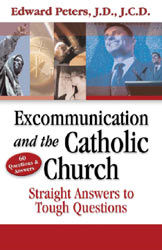 A note from