| To work for the proper implementation of canon law is to play an extraordinarily constructive role in continuing the redemptive mission of Christ. Pope John Paul II |
| |
| | |
| | |
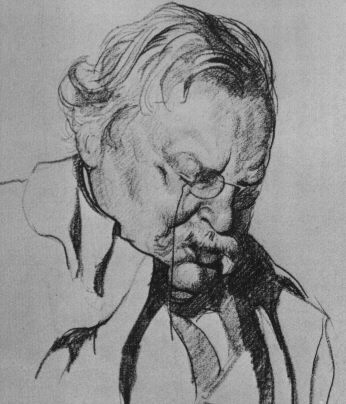
| Resolution 1152 x 864 | Updated 6 jan 2013 | An Introduction to Gilbert Keith Chesterton |
| Edward Peters, "An Introduction to Gilbert Keith Chesterton", Catholic Faith (Nov-Dec 1996) 31-32. |
|
| [Here] is the real objection to that torrent of modern talk about treating crime as disease...The fallacy of the whole thing is that evil is a matter of a active choice whereas disease is not... A man may lie still and be cured of a malady. But he must not lie still if he wants to be cured of a sin; on the contrary, he must get up and jump about violently. The whole point indeed is perfectly expressed in the very word we use for a man in hospital; "patient" is in the passive mood; "sinner" is in the active. If a man is to be saved from influenza, he must be patient. But if he is to be saved from forging, he must not be a patient, but an impatient. He must be personally impatient with forgery. All moral reform must start in the active not the passive will. G.K.C, Orthodoxy
I posted this quote on my locker in Law School, the semester we took basic criminal law. It occasioned some good exchanges. enp
| Chesterton is often called the most quoted man in English; he was certainly one of the most prolific. Beyond his vast literary output, his exhaustive public speaking and debating work did much to advance the cause of common sense in general, and of Christian spiritual wisdom in particular. Indeed, Chesterton's conversion to the Catholic Church in 1922 was (second only to the disruption of the First Vatican Council during the Italian Revolution) the most talked-about religious event in Europe since the conversion of fellow Englishman John Henry Newman some 75 years earlier.
Upon his death, Chesterton was named by Pope Pius XI a "Defender of the Catholic Faith" thereby redeeming somewhat a similar title bestowed on but squandered by another Englishman 400 years earlier. His devoted wife of 35 years, Frances Blogg, who helped bring the younger Chesterton out of a confused mishmash of world-views into a more critical Christianity, eventually followed her husband into the Church and died just two years after him.
Fr. John Hardon has said that "the best word to describe Chesterton's writings is brilliant" and no serious Catholic American leader today is unfamiliar with his works. Because Chesterton's writings fill such a wide scope of topics and styles, one can begin studying him almost anywhere. But the following suggestions might help to get one started. Poetry
Almost all of Chesterton's poetry rhymes. Moreover, for all its beauty and brilliance, it makes immediate sense to the average reader. It easily lends itself to either silent study or oral recitation. Although much of Chesterton's poetry is humorous (e.g., satires on British politics) some of it is bardic and historical and, because Chesterton always saw the finger of God in history, it is deeply inspirational without becoming pietistic.
By any measure Chesterton's epic "Ballad of the White Horse" is his poetic masterpiece. Its narration of the fierce struggle between the Christian princes of England and the pagan Nordic chiefs was so poignant that the British press freely and frequently quoted from it during the Second World War when England stood alone against neo-pagan Nazism.
A much shorter, but still wonderful, poem in the manner of White Horse is "Lepanto", the story of the naval battle in 1571 which saved Europe from Moslem invasion and which gave the Church the feast of Our Lady of the Rosary (October 7). Almost all of Chesterton’s poetry is found conveniently and affordably in The Collected Poems of G. K. Chesterton (Dodd & Mead, 1980).
Fiction
Chesterton’s fiction falls into two types: short novels and even shorter short-stories. Despite their relative brevity, at least two of Chesterton’s novels rank among the best fiction works produced this century. The Napoleon of Notting Hill, released in 1904, is proposed by many as the best first novel ever written by any of England's many great fiction writers. Just four years later, though, The Man Who Was Thursday proved forever Chesterton's skill for serious literature in a book that was then, and remains now, renowned for both its secular appeal and its Christian perception.
Throughout his career, Chesterton worked on and published the short detective thrillers thanks to which, more than any other of his writings, he is most widely known. The "Father Brown" series are not just entertainment, for Fr. Brown's unique ability to solve crimes is based on his priestly knowledge of human nature and foreshadows what Pope Paul VI would say many decades later: the Church is an expert in humanity. Complete sets are widely available - but if you acquire the Father Brown series in parts, start with the stories in The Innocence of Father Brown. You will have the main characters more clearly in mind that way. Also available is the new series from Ignatius Press: Father Brown and the Church of Rome, which includes stories in which Father Brown's Catholic Faith plays a central role in solving crimes.
Non-Fiction
Even if one discounts the mass of material written by Chesterton the journalist, the non-fiction works of Chesterton as social commentator, philosopher, theologian, biographer, and literary critic are daunting. One's own tastes and interests are the best guide here, but at least two works stand out no matter what one's other reasons for reading Chesterton: St. Francis of Assisi (1923) and The Everlasting Man (1925).
The first is a short biography of, second only to Our Lady, the most popular Catholic saint. Not a collection of dates and places, Chesterton's superb picture of St. Francis will forever keep the founder of the world's largest religious family from being relegated like a curio to a collection of eccentric bird lovers. The second book, a somewhat longer but still very approachable work, was originally written as a corrective to H. G. Well's biased and naive Outline of History, but Chesterton went far beyond that immediate goal and penned his own interpretation of human history, a history which Chesterton showed can make sense only if it is seen in the light of Christ.
Finally, if one is already a fan of other authors like Robert Louis Stevenson, Robert Browning, or especially Charles Dickens, Chesterton's remarkable studies of the works of these leading authors must be consulted. George Bernard Shaw, for example, one of Chesterton's steadiest opponents and most devoted admirers, once called Chesterton's book on his writings "the best piece of literary criticism I have ever inspired.
Biographies
It is not surprising that Chesterton's life has spawned so many biographies, each with their strengths and weaknesses. All of them agree, however, on their debt to the first biography of G. K. Chesterton, Maisie Ward's Gilbert Keith Chesterton (Sheed & Ward, 1944). Read this life first (even before Chesterton's own Autobiography) and then you can better select among the many others.
Interest in, and appreciation for, Chesterton’s work has always remained strong, but recently it seems to be spreading with renewed vigor. Ignatius Press, mentioned earlier, is well along in its project of publishing the complete works of Chesterton. Another important contributor to that growth is due to the quarterly journal, The Chesterton Review, edited by Fr. Ian Boyd, C.S.B., and published by the G. K. Chesterton Society out of St. Thomas More College in Saskatoon, Canada. Regional meetings, notably the periodic Lewis/Chesterton Conference held in Seattle, are another source of continuing study of the life and work of this great man. Many communities also have Chesterton reading and discussion groups, some of them sponsored by the Chesterton Society.
|