| Be sure to check my SHMS Students Page for general information pertaining to all of my courses! Some general points 1. A syllabus is a guide, not a contract. 2. Avoid the "message tag" trap. E-mails and phone calls are not considered sent by you until they are retrieved by me. 3. No recordings of any kind may be made in my classes. Any materials that I distribute are offered for student use only, and all other rights are reserved. 4. Academic calendars are highly susceptible to curvatures in space-time. The closer one gets to the end of a semester, the more quickly time moves. Don't wait till the end of term to address questions or concerns! 5. One might take an academic program part-time, but one can't take a college or graduate level course part-time. 6. SHMS Faculty are welcome to sit in any of my classes at any time! Some good (not perfect, but good) documentaries Inside the Vatican (National Geographic, 2002) Love is a Choice: St. Gianna Beretta Molla (Salt & Light, 2004?) The Catholic Print Media You are not limited to the following, but this list can help get you started. All of these publications are in the SHMS Szoka Library. Some Major Catholic News & Comm. Monthlies Catholic World Report Crisis, First Things* Homiletic & Pastoral Review Inside the Vatican Some Major Catholic News & Comm. Weeklies America National Catholic Register National Catholic Reporter Our Sunday Visitor Some Other Notable Catholic Publications The Catholic Answer U.S. Catholic, This Rock * Does not claim to be Catholic | | Sacred Heart Major Seminary Students
Introduction to the Catholic Church (THE 219.5) Wednesdays evenings, 6:30 to 8:30 PM | General Remarks Per the SHMS Bulletin, "this course investigates the history, culture, customs, piety and concrete life of the Church in light of the teachings of Second Vatican Council." That's a tall order, but it is do-able with the help of, among other things, a common Catholic "vocabulary", not just a vocabulary of words, but of persons, movements, institutions, and social manifestations. That is what we will be aiming to achieve this semester. This course is graded by: 1) a series of quizzes, announced or not, which tend to focus on most recently read and/or lectured materials, but which can be cumulative; 2) semester projects (see below); and 3) class participation (which means active participation, as shown by responding to my questions, surfacing relevant issues for attention, and so on). Please be punctual. Desk drinks are fine, but no eating in class. No recording of any kind is permitted in this class. | 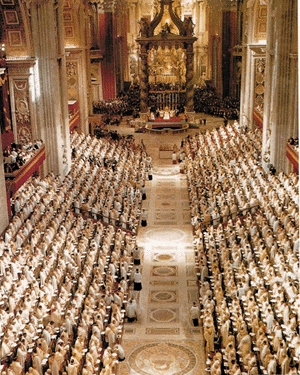 Second Vatican Council in plenary assembly | Required Texts -
J. Trigilio & K. Brighenti, Catholicism for Dummies (For Dummies, 2003 or later). -
Catholic Almanac (Our Sunday Visitor, annual). Accurately billed as "The Most Complete One-Volume Encyclopedia of Facts and Information On The Catholic Church", and it is. Any edition from 2008 on is fine. -
The Documents of Vatican II, any language. Available on-line. Recommended Texts -
Catechism of the Catholic Church, 2d ed., (Libreria Editrice Vaticana, 1997). Any language. -
Marcellino D'Ambrosio, Exploring the Catholic Church (Servant Books, 2001). -
P. Stravinskas, ed., Our Sunday Visitor's Catholic Encyclopedia, rev. ed. (Our Sunday Visitor, 1991/1998. A very solid, one-volume reference. (All canon law and many Church history entries were written and/or edited by Dr. Peters). Some Other Generally Useful Resources It is not necessary to own these works, of course, but to know that they are out there and have much to offer students of the Catholic Church. In no particular order, they include: -
The Catholic Encyclopedia (1907-1914). On-line at New Advent. Still worth consulting. -
Dictionnaire de Théologie Catholique (1923-1946). Reason enough to learn French. -
The New Catholic Encyclopedia (1967), 17 vols., quite under-rated. -
The New Catholic encyclopedia, 2d ed., (2002). Often repetitious of the first, but still useful. -
Romano Guardini, The Church and the Catholic [1935] (Sheed & Ward, 1953). Almost timeless. -
Catherine Frederic, The Handbook of Catholic Practices (Hawthorn, 1964). Dated, but useful. Semester Scheduling Guide (Winter 2010) | Week | Required Reading | For best results, read before class, then again after | Project due dates | | 1 | CfD Intro & Chap. 1 | Paul VI, Credo of the People of God | | | 2 | CfD Chap 2 | Popes of Vatican II (John XXIII thru Benedict XVI) Kenedy & Sons, The Official Catholic Directory | | | 3 | CfD Chap 3 & 4 | Arch/diocesan leadership list | Catholic Sites/Blogs I | | 4 | CfD Chap 5 & 8 one | Popes of the 20th century (Leo XIII to Benedict XVI) | Catholic Almanac Project | | 5 | CfD Chap 5 & 8 two | | Catholic Press I | | 6 | CfD Chap 6 & 7 | | | | 7 | CfD Chap 9 & 10 | The Precepts of the Church CCC 2041-2043 | Film report 1 | | 8 | CfD Chap 11 | | Butler's Lives | | 9 | Spring Break | | | | 10 | CfD Chap 12 | Baptism | Film report 2 | | 11 | CfD Chap 13 | 1983 CIC 1055 & Marriage NB: Dr. Peters is sick, no class MAR 24. Push readings back one week. | Catholic Press II | | 12 | CfD Chap 14-16 | | | | 13 | CfD Chap 17-19 | VCII, Lumen gentium, esp. chap. 5 | | | 14 | Review and optional topics | Optional Meeting & Summations | last day, Baptismal Certificates | | 15 | | Final Exam, April 21 | | Semester Projects: 1. Catholic Websites and Blogs Identify 4-6 websites/blogs by Catholics, paste their URLs into an email to Dr. Peters, and briefly describe their character (Catholic Sites/Blogs I). Monitor during the semester these blogs for updates, and briefly describe major issues or trends observed during that time (Catholic Blogs II). Catholic Blog Directory. | 2. The Catholic Church in Film The films listed to the right treat the Catholic Church in a respectful manner. Pick any two and view them. In 200-300 word reports for each film you pick, indicate the date you watched the film and discuss the following points: 1) the accuracy of the depiction of Catholic issues in the film; 2) any significant errors or omissions that, from a Catholic perspective, should be borne in mind; 3) the audience most likely to benefit from viewing the film. Do not waste words rehearsing the plots! You may, and perhaps should, watch the films with other students, but each student must submit his or her own report. Submit in an e-mail only, no attachments. | Basic info at: Internet Movie DataBase H. King, Song of Bernadette (1943) A. Hitchcock, I Confess (1953) E. Kazan, On the Waterfront (1954) D. Mann, Marty (1955) R. Nelson, Lilies of the Field (1963) P. Glenville, Becket (1964) C. Reed, The Agony and the Ecstasy (1965) F. Zinneman, A Man for All Seasons (1966) M. Anderson, Shoes of the Fisherman (1968) W. Allen, Alice (1990) F. Costa, Mother Teresa (2003) V. Schlöndorff, The Ninth Day (2004) | 3. The Catholic Press Identify and describe (e.g., format, editor/publisher, circulation, etc.) five significant Catholic periodicals with national circulation. Make sure there are monthlies and weeklies on your list. Submit the list and descriptions via email only to Dr. Peters (Catholic Press I). Monitor one monthly and one weekly, and report on some of the major news items or editorial positions observed during the semester. Submit your report in 200-300 words via email only to Dr. Peters (Catholic Press II). | 3. Butler's Lives of the Saints, edited by Thurston & Attwater in 4 volumes Find your patron saint or blessed in Butler's Lives. Give the complete citation, and then summarize your patron's life in 100-150 words. Describe briefly the sources that are referenced at the end of the biographical sketch. Submit by email only. (If your patron is not in Butler's, see me.) Sample: St. Edward the Confessor, 1002-1066, King and Confessor. See Butler's Lives, IV: 100-103 (October 13). [100-150 word summary] Based on early Norman-French and Latin poems, the Analecta Bollandiana and several 19th century historical studies. Advises caution as far as Edward's reputation as a lawgiver is concerned. | 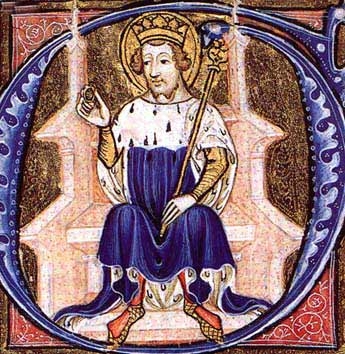 St. Edward the Confessor King of England, 1042-1066 | | 5. Baptismal Certificate Secure an authentic copy of your baptismal certificate, recently dated, and show it to Dr. Peters anytime during the semester. You may keep the certificate. • How do you find your church of baptism? • What if your mom doesn't remember? • What information helps church archivists find your baptismal record quickly? It is customary, but not required, to include a check for a couple of dollars with your certificate request. | 17th century French-Canadian baptismal certificate 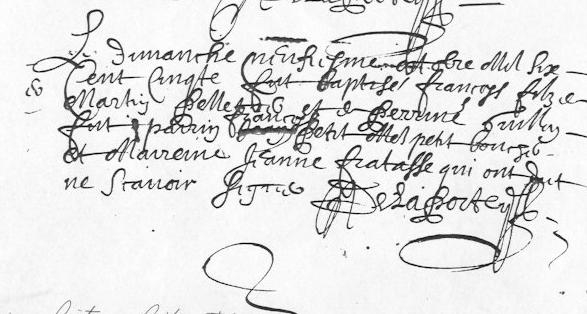 Note: Your baptismal certificate will probably not be in cursive legal French script nor on parchment. Don't worry, it still counts. |
Top || Home || Canon Law || Liturgy & Sacraments || Catholic Issues || Personal
|